
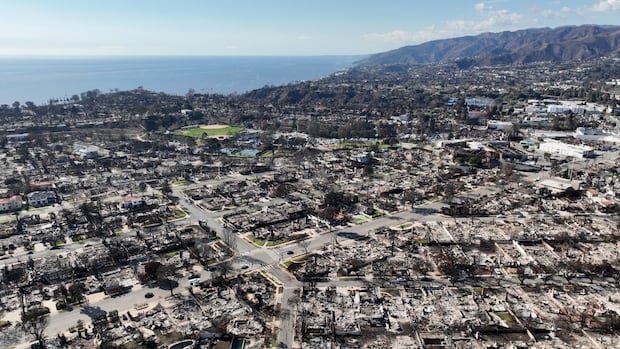

A 29-year-old individual accused of initiating the most devastating fire in Los Angeles history is believed to have used a lighter to start a fire on New Year’s Day. The fire smoldered underground and reignited nearly a week later, resulting in the tragic deaths of 12 individuals in an affluent hillside area, authorities revealed on Wednesday.
Federal law enforcement officials have charged Jonathan Rinderknecht with igniting the fire on January 1, which was initially put out by fire crews but flared up again amidst high winds. Acting U.S. attorney Bill Essayli disclosed this information during a press conference. Rinderknecht was apprehended in Florida on Tuesday and was scheduled to appear in court on Wednesday to face charges, including malicious destruction by fire, which carries a mandatory minimum prison sentence of five years. Aisha Nash, the federal public defender representing Rinderknecht, has not provided any comments to The Associated Press.
The Palisades Fire, one of two fires that erupted on January 7 and claimed over 30 lives while destroying numerous homes across Los Angeles County, ravaged hillside communities in Pacific Palisades and Malibu. It obliterated mansions boasting breathtaking views of the ocean and downtown Los Angeles.
Covering more than 9,308 hectares, the fire consumed around 6,000 structures in Los Angeles and caused an estimated $150 billion in damages. Investigators disclosed that Rinderknecht had been working as an Uber driver and, after dropping off a passenger in Pacific Palisades, parked his vehicle and proceeded up a trail. Utilizing his iPhone, he recorded videos at a nearby hilltop area and listened to a rap song with a music video depicting objects being set on fire, according to prosecutors.
Rinderknecht fled the scene after igniting the fire but returned to the same trail to witness the flames, remarked Essayli. He made multiple 911 calls to report the fire, as per a criminal complaint. During an interview on January 24, Rinderknecht provided investigators with details about the fire’s origin, which had not been made public, asserting that he would not have known unless he had witnessed it firsthand.
The suspect falsely claimed he was near the base of the hiking trail, added Essayli. During the interview, Rinderknecht displayed visible anxiety, and his actions of calling 911 and inquiring about the possibility of a cigarette causing a fire suggested he aimed to create evidence depicting his efforts to assist in fire suppression and establish an innocent explanation for the fire’s cause.
Authorities concluded that the fire on January 1 was deliberately set, likely using a lighter to ignite vegetation or paper, based on the criminal complaint. They ruled out other potential causes such as fireworks, lightning, and power lines. While investigating whether a cigarette could have sparked the fire, they dismissed this possibility as well.
On January 24, investigators discovered a “barbecue-style” lighter within the glove compartment of Rinderknecht’s vehicle. It appeared identical to a lighter seen in his apartment on December 31, as shown in a photo on his phone. Rinderknecht admitted to carrying a lighter when he hiked up the hill.
Following an extensive investigation by the Los Angeles field division of the U.S. Bureau of Alcohol, Tobacco, Firearms and Explosives (ATF), the Los Angeles Fire Department, and the Los Angeles Police Department, Rinderknecht faces three federal criminal charges related to the fire.
The cause of a second blaze, the Eaton Fire, which erupted on the same day in the Altadena community and claimed 19 lives, remains undetermined. These fires left entire neighborhoods in ruins, necessitating years for reconstruction. Many homeowners, even those with insurance, may struggle to afford rebuilding.
An independent review highlighted deficiencies in resources and outdated emergency alert policies that led to delayed evacuation notices. The report, commissioned by Los Angeles County supervisors, identified various weaknesses that hindered the county’s response, including obsolete policies, inconsistent practices, and communication vulnerabilities.