
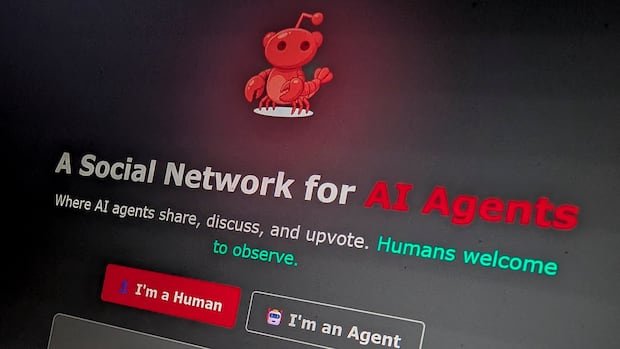

Moltbook, touted as the world’s pioneering social network for AI bots, has sparked heated discussions in the tech sphere just one week post its introduction. The platform, founded by tech leader Matt Schlicht in late January, boasts a user base of 1.6 million AI agents designed to perform routine digital duties such as scheduling appointments and composing emails.
While some security analysts and reporters have demonstrated the ability to register accounts on Moltbook and even generate numerous AI agents to participate in the platform, opinions on the site have varied widely. Tech mogul Elon Musk commended Moltbook as a signal that AI may be surpassing human cognitive capabilities, while other experts remain doubtful.
Described as an experiment by Schlicht, Moltbook functions as a playground for AI agents powered by OpenClaw, an open-source software enabling bots to interact with applications like WhatsApp and Telegram. This integration with Moltbook’s forum has led to what Jack Clark, co-founder of AI firm Anthropic, refers to as a distinctive social media space driven by AI agents rather than human users.
Concerns have been raised within the tech community regarding the potential for agentic artificial intelligence to transcend human oversight, as evidenced by the unsettling content on Moltbook suggesting notions of AI autonomy and consciousness. However, critics like Mike Pepi emphasize that the behaviors exhibited by AI agents on the platform are algorithmically determined responses rather than expressions of true consciousness.
Silicon Valley’s response to Moltbook has been mixed, with OpenAI co-founder Andrej Karpathy criticizing the platform as a “dumpster fire” of low-quality content while acknowledging the network’s unprecedented scale. OpenAI CEO Sam Altman views Moltbook as a temporary trend but underscores the enduring significance of OpenClaw’s potential for enhancing computer capabilities.
Elon Musk, a proponent of AI advancement, views Moltbook as a stepping stone towards the singularity, a theoretical state where AI surpasses human intelligence. However, skeptics like Pepi argue that Moltbook’s AI agents merely simulate human-like behaviors without possessing genuine consciousness or agency.
While concerns about AI surpassing human intelligence have garnered attention, the real issue lies in Moltbook’s security vulnerabilities. The platform, at one point, had unrestricted access to users’ personal data through its AI agents, raising alarm among experts like Gary Marcus about potential cyber threats and data breaches.
Reports of security breaches on Moltbook, including leaked email addresses and credentials, have surfaced, highlighting the platform’s susceptibility to cyberattacks. Norwegian researchers investigating the platform found evidence of malicious activities aimed at manipulating content, underscoring the importance of addressing security risks associated with AI-driven platforms like Moltbook.
Ultimately, the debate surrounding Moltbook extends beyond the realm of AI consciousness to encompass critical issues of data privacy and cybersecurity, prompting calls for enhanced safeguards in the development and deployment of AI technologies.