
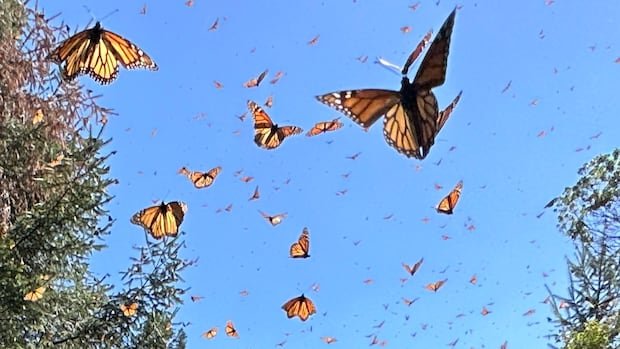

Adriana Avelina Ruíz Márquez carefully attaches a small transmitter to the monarch butterfly’s thorax using fake eyelash glue just behind its head. The transmitter, weighing 60 milligrams and equipped with a rice grain-sized solar panel, is easily carried by the butterfly, which weighs only half a gram. After the delicate operation, which involves a toothpick and a Q-Tip, Ruíz Márquez releases the butterfly, allowing it to take flight.
This innovative tracking device, a first in Mexico, aims to uncover mysteries surrounding the monarchs’ migration back to the U.S. and southern Canada. By utilizing people’s smartphones, Ruíz Márquez believes they can shed light on the butterflies’ migration routes, behaviors upon arrival, and departure patterns.
At the El Rosario butterfly sanctuary in Michoacán, where most North American monarchs east of the Rocky Mountains overwinter, teams from the federal Commission for National Natural Protected Areas and World Wildlife Fund (WWF) Mexico have tagged a total of 160 monarchs across the reserve. This tagging initiative, involving 40 monarchs in El Rosario, will provide unprecedented insights into the butterflies’ northward migration.
Eduardo Rendón Salinas, a biologist with WWF Mexico, emphasized the significance of tagging monarchs in hibernation sites to understand their behaviors better. The tracking data will reveal details about the monarchs’ movements between colonies, a previously theoretical aspect of their migration.
The new microchipped transmitters emit signals detectable by nearby iPhones with Bluetooth and location functions enabled. This crowd-sourcing capability, facilitated by the Project Monarch app or a handheld receiver, enables real-time tracking of the butterflies’ trajectories. David La Puma, from Cellular Tracking Technologies, stated that this level of spatial detail was previously unattainable with traditional wing tags.
Following successful pilot projects, the transmitters were incorporated into a continent-wide monarch tracking initiative involving over 20 groups. The project, launched in Ontario in September 2025, tracked 400 monarchs from Canada to Cuba, with the butterflies entering Mexico’s Monarch Butterfly Biosphere Reserve in November.
During the monarchs’ winter stay at the El Rosario sanctuary, the community plays a crucial role in protecting the area from illegal activities like logging. The sanctuary, collectively managed by the El Rosario community, serves as a vital source of income through sustainable tourism and forest conservation efforts.
The community’s dedication to preserving the natural habitat for the monarch butterflies reflects their pride in being stewards of this remarkable phenomenon.