
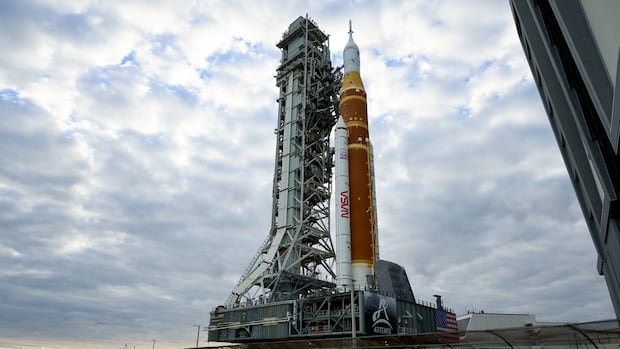

NASA’s latest moon rocket encountered another setback on Saturday, likely delaying astronauts’ first lunar journey in decades to the spring season. The space agency disclosed the issue after setting March 6 as the target date for the Artemis II mission, marking humanity’s initial moon flight in over 50 years. The helium flow to the rocket’s upper stage was disrupted overnight, a critical function for engine purging and fuel tank pressurization.
This helium complication is distinct from the hydrogen fuel leaks that affected a recent countdown rehearsal of the Space Launch System rocket, leading to a repeat test. NASA Administrator Jared Isaacman suggested a faulty filter, valve, or connection plate could be responsible for the halted helium flow. The only way to address the problem is by accessing the area in the Vehicle Assembly Building at the Kennedy Space Center in Cape Canaveral, Fla.
Isaacman announced on social media platform X that preparations for rollback would commence, eliminating the possibility of a March launch and pointing to potential opportunities at the beginning or end of April. Despite the setback, Isaacman expressed gratitude for NASA’s dedicated team preparing for the mission.
Earlier, NASA indicated plans to return the 98-meter rocket to its hangar for repairs, with a consideration for conducting the work at the pad. The Artemis II lunar fly-around had already been delayed by hydrogen fuel leaks, prompting a second fueling test that revealed minimal leaks, allowing for a March liftoff target. The astronauts entered a two-week quarantine on Friday to prevent any infections.
The helium flow issue specifically affects the SLS rocket’s interim cryogenic propulsion stage, crucial for positioning the Orion crew capsule into the correct high-altitude orbit for post-launch checks. The stage is intended to detach from Orion and serve as a docking target for astronauts to practice maneuvers for upcoming moon missions.
While the Apollo program saw 24 astronauts journey to the moon between 1968 and 1972, the Artemis program has only seen one crewless lunar-orbiting mission in 2022. This initial test flight also faced hydrogen fuel leak challenges before takeoff. A crewed moon landing under Artemis remains several years away.