
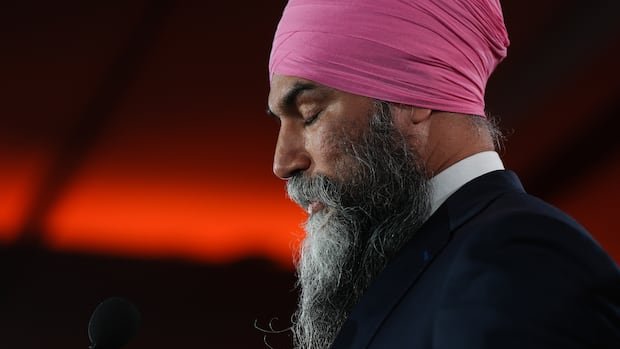

The federal New Democratic Party (NDP) unveiled its internal post-election analysis on Friday, steering away from assigning blame to senior party figures and instead pointing to external factors as contributors to its disappointing electoral performance. The review acknowledged that despite running a well-executed campaign, the party faced significant challenges beyond its control, with little room for altering the outcome significantly in terms of seat numbers.
Drawing insights from feedback provided by former and current members, the report highlighted a range of external influences that hindered the NDP’s electoral success. These factors included a political climate that overshadowed domestic issues with a focus on comparisons to U.S. President Donald Trump, as well as persistent questioning from the media regarding the party’s bleak polling outlook.
During the April election, the NDP suffered heavy losses, retaining only seven of its 24 seats, with party leader Jagmeet Singh also losing his seat in British Columbia and subsequently resigning on election night. The report indicated that voters had already formed a mindset reminiscent of Trump, Pierre Poilievre, and Mark Carney, presenting challenges for the NDP to counter this narrative effectively and convey its message on key issues like housing and affordability.
Despite the campaign facing setbacks such as low polling numbers and modest event turnouts, the report noted that outwardly, the operation did not appear to be in disarray. It commended the professionalism of the campaign tour, well-organized events, strong leadership performance by Singh, and adequate funding for battleground campaigns.
The analysis underscored the necessity for a more assertive and progressive campaign approach, pointing out deficiencies in the party’s messaging clarity leading up to the election. The report highlighted that the NDP’s messaging, particularly around the confidence and supply agreement with the Liberals, missed opportunities to showcase its role as a robust progressive opposition and potential future government.
Moreover, the report emphasized the importance of prioritizing local candidates in less prominent ridings over a leader-centric focus, along with addressing concerns raised by candidates about insufficient resources and support during their campaigns. It urged local party executives to establish realistic expectations and objectives for candidates.
Additionally, the review identified a prevalent reluctance among NDP supporters towards fundraising, describing it as a structural weakness that hampers the party’s financial sustainability. Participants in the review called for a more strategic and modernized fundraising approach to avoid accumulating debt and enhance campaign efficiency.
The report also criticized the party’s allocation of resources, highlighting an overemphasis on traditional television advertising at the expense of digital marketing. It noted that the advertising content lacked substantial political messaging and failed to address voters’ main concerns regarding issues such as Trump, trade tariffs, and national sovereignty.
Addressing the need for a more inclusive and impactful communication strategy, the report pointed out that the NDP’s language often appeared distant and moralizing to workers, lacking a coherent plan on economic affordability, trade policies, and industrial development.
As the NDP embarks on a leadership selection process scheduled for March, the report serves as a critical evaluation tool to guide the party’s future direction and strategic planning.