
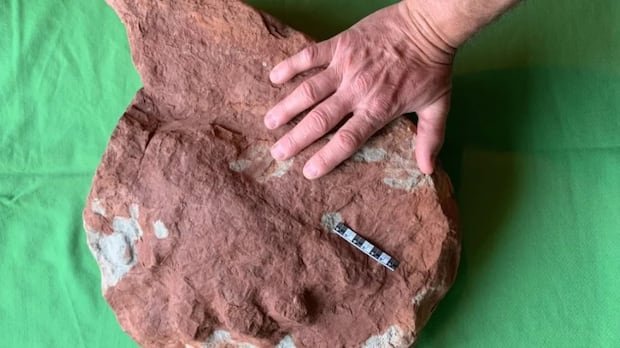

Prince Edward Island is becoming recognized for more than its traditional attractions of Anne of Green Gables, beaches, and potatoes. A geologist from Nova Scotia, John Calder, working with the P.E.I. government to identify fossils, revealed that the province is now gaining global attention due to a series of recent fossil discoveries.
Contrary to the belief that P.E.I.’s red sandstone, referred to as “red beds” in geology, does not preserve fossils well, Calder explained that this assumption is inaccurate. With a surge in findings, P.E.I. is shedding its reputation as a barren ground for fossils and is poised to join the ranks of significant geological sites from that era.
The recent influx of discoveries has largely been driven by local residents rather than professional scientists. Notably, Patrick Brunet, a resident of North Rustico, has unearthed many of the fossils found on the island in recent years through his keen eye and dedication to learning about significant fossils.
Islanders will have the opportunity to view these discoveries up close during Fossil Day on April 10, organized by the P.E.I. Museum and Heritage Foundation at the Charlottetown Library Learning Centre. Additionally, Calder will share insights into the fossil findings at a Nature P.E.I. meeting on April 7 at Beaconsfield Carriage House.
Calder, who authored “Island at the Centre of the World” in 2018, delved into P.E.I.’s geological history, dating back nearly 300 million years to the Permian period. During this era, characterized by warm climates, the red rocks of P.E.I. were formed as rivers deposited sediments that quickly solidified, preserving footprints of various ancient creatures like reptiles and amphibians.
As the custodian of over 100 fossils discovered by Brunet last year, Calder highlighted the potential for these findings to establish a permanent collection. He envisioned a future where P.E.I. could boast a museum showcasing these fossils, not only for academic research but also for the public to marvel at and appreciate the island’s rich paleontological heritage.