

Pigeons have a long history of playing diverse roles, from delivering messages during the Olympic games in Greece to smuggling drugs into prisons. In a new study led by the University of British Columbia in Vancouver, researchers have enlisted pigeons to aid in developing more advanced drone technology.
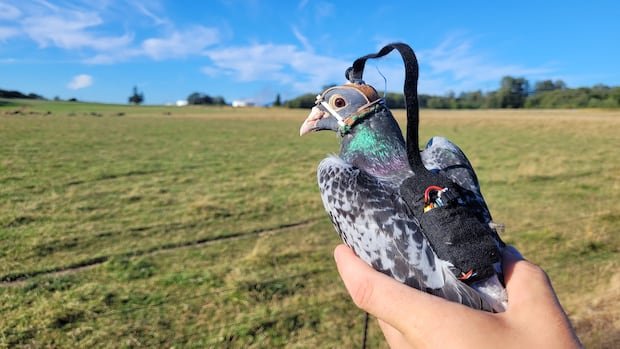
The study, recently published in Current Biology, involved equipping homing pigeons with miniature backpacks containing a small computer and head-mounted cameras to observe their eye movements during flight. The entire setup weighed around 27 grams, including a compact computer, a modified commercial camera, and sensors to monitor the birds’ movements and orientation.
Anthony Lapsansky, the lead researcher who conducted the study at UBC, mentioned that fitting the equipment onto the pigeons required meticulous effort and experimentation. He crafted various sizes of falconry hoods to secure the camera on the birds’ heads and designed tiny backpacks for the remaining gear. Lapsansky described the process of gradually introducing the equipment to the pigeons by initially using fake backpacks to ensure they became accustomed to the setup without distress.
The researchers collaborated with a group of approximately 16 pigeons, releasing them along a familiar route so they could return to their home loft. Once the pigeons returned, the researchers retrieved the recorded footage by removing the equipment.
The study revealed that pigeons exhibit slow, subtle eye movements during flight, suggesting they utilize these movements to gather detailed information about their surroundings. Additionally, the researchers observed that pigeons align both eyes inward when landing on a perch, enabling them to focus on the perch with both eyes simultaneously. This behavior indicates that pigeons may process depth information similarly to humans, contrary to the common belief that pigeons maintain fixed eyes during flight.
David Bird, an emeritus professor of wildlife biology at McGill University, commended the study for debunking the assumption that birds lock their eyes in place while flying. He noted that previous research had indicated otherwise, with varying results based on the flight conditions and surroundings of the pigeons being observed.
The study’s findings could have implications for drone technology, as Lapsansky suggested that incorporating movable cameras on drones could enhance their ability to gather information from the environment. Bird, who has experience working with drones, emphasized the potential benefits of utilizing more adaptable cameras on drones to improve their efficiency in diverse tasks.
Overall, the study sheds light on the intricate eye movements of pigeons during flight and highlights the potential applications of their behavior in advancing drone technology for various purposes.
[Source](https://www.cbc.ca/news/canada/british-columbia/pigeons-wearing-cameras-can-improve-how-drones-fly-9.7267617)