
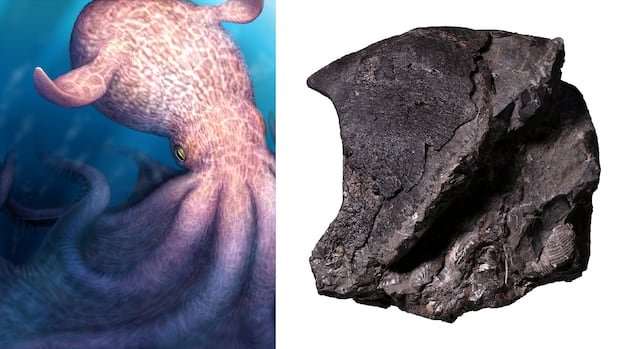

Monstrous octopuses, comparable in size to modern whales, roamed the oceans alongside dinosaurs, seizing prey with their massive tentacles and crushing them with formidable jaws, as evidenced by fossils discovered in British Columbia and Japan. A recent study published in the journal Science reveals that these sea creatures, resembling mythical tentacled monsters like the Kraken, reached lengths of up to 19 meters, akin to a sei whale’s size.
The study, led by Yasuhiro Iba from the University of Hokkaido, describes two species, with one, Nanaimotethis haggarti, potentially ranking among the largest invertebrates in Earth’s history. In comparison, the largest known modern invertebrate, the giant or colossal squid, reaches lengths of approximately 12 meters.
Commenting on the findings, Cameron Tsujita, a paleontology professor at Western University, London, Ontario, described Nanaimotethis as “terrifyingly large,” even when considering potential measurement errors. The fossils’ preserved beaks exhibited wear patterns indicating these ancient octopuses had the ability to consume heavily protected prey, such as those with hard shells.
During a period dominated by massive marine reptiles like mosasaurs and elasmosaurus, the presence of these enormous octopuses would have added to the predatory hierarchy, posing threats to smaller marine creatures like fish, sea turtles, and ammonite relatives. Iba emphasized that the study highlights the significant role played by giant invertebrates, specifically octopuses, as top predators in ancient marine ecosystems.
A notable observation from the study was the asymmetrical wear on the octopuses’ jaws, suggesting a potential preference for capturing prey on one side, a trait associated with intelligence. This finding raises questions about the intelligence of these ancient creatures, mirroring the known intelligence of modern octopuses.
The fossils, primarily beaks or jaws made of chitin, a hard protein also found in lobster and beetle shells, were unearthed in rock formations in British Columbia and Hokkaido. Unlike soft-bodied organisms, octopus fossils are rare due to their composition, with only chitinous structures like beaks occasionally fossilizing.
To obtain detailed specimens, researchers utilized a technique called “digital fossil mining” or “grinding tomography,” involving the layer-by-layer shaving of rocks containing hidden fossils. By reconstructing 3D models from high-resolution images, the team confirmed that the Nanaimotethis species were not vampire squids as previously believed but finned octopuses, similar to deep-sea dwelling modern counterparts.
The study places these ancient octopuses between 100 to 72 million years ago, making them the oldest known octopus fossils, shedding light on their early evolution. The significant differences between Nanaimotethis and present-day octopuses prompt intriguing questions about the evolutionary path that led to the current form of these intelligent cephalopods.