
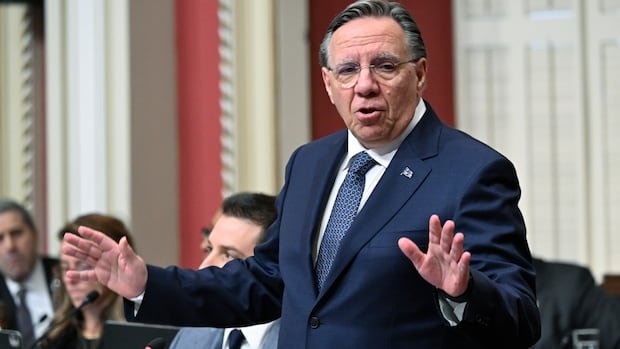

Quebec Premier François Legault has issued a warning that if an agreement with the province’s doctors and medical specialists is not reached by Friday morning, his government will introduce a special law to enforce changes to compensation and put an end to pressure tactics. In a video message posted on X Wednesday evening, Legault emphasized that the government’s actions are aimed at benefiting the people of Quebec rather than being against the doctors.
While acknowledging the expertise of doctors, Legault stressed their duty to provide care to residents, particularly the most vulnerable. The situation escalated last week when Quebec family doctors halted their medical student teaching activities, following the lead of medical specialists. Subsequently, negotiations between medical specialists and the provincial government hit a deadlock, leading to the suspension of mediation earlier this week.
Legault, speaking in the video, mentioned that the proposed special law would also quash pressure tactics that are impeding the entry of future doctors into the healthcare system. He acknowledged that there might be protests from doctors and specialists in the coming days but reiterated that this step is essential to ensure residents receive adequate healthcare access.
In the nearly three-minute video, Legault expressed hope that the medical associations would be open to compromise to reach a mutual agreement. Shortly after the video release, the medical specialists’ association released a statement expressing skepticism, stating that they felt manipulated and suggested that the government orchestrated the situation to justify imposing the special law.
This development followed the rejection by medical specialists of Quebec’s fourth offer to doctors, which included assurances of funding to address concerns related to performance-based pay under Bill 106. The proposal outlined that the regulations tying physician compensation to performance metrics would remain unchanged for the initial two years after the law’s implementation. Additionally, it included commitments of $50 million for 500 additional healthcare professionals in family medicine groups by 2026 and $120 million over four years to enhance the patient-physician matching system.
To tackle operating room shortages, Quebec pledged $400 million over four years to add eight new operating rooms and enhance management. The offer also proposed performance targets linked to pay for executives at Santé Québec. The additional funding was intended to assist doctors in meeting performance goals, with a planned 30% increase in healthcare professionals across the network.
Vincent Oliva, the head of the medical specialists’ association, criticized the offer as repetitive and called for a non-binding arbitration mechanism, labeling Quebec’s latest proposal as a “declaration of war.” Meanwhile, the family doctors’ association stated its intention to review the proposal before issuing a formal response.
Health Minister Christian Dubé underscored the urgency of passing Bill 106, citing public frustration over prolonged wait times for emergency care and specialist appointments.