
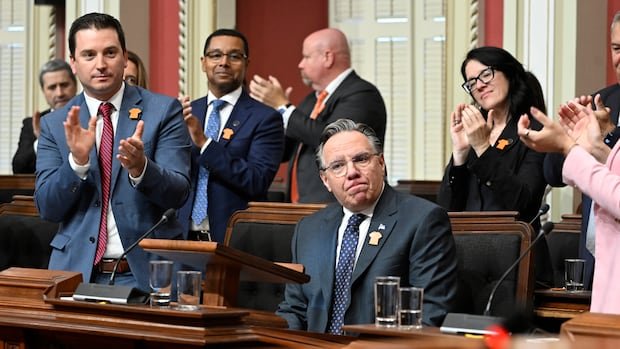

Premier François Legault’s bold pledge to protect Quebecers from “radical Islamists” by prohibiting public prayer has sparked renewed discussions that have shaped the province’s political landscape over the past two decades.
During a recent session at the National Assembly, Legault raised concerns about threats to Quebec’s identity from what he referred to as “politico-religious” factions, particularly emphasizing the challenges to women’s equality posed by radical Islamists.
In a bid to outdo one another, the Parti Québécois, led by Paul St-Pierre Plamondon, not only endorsed the Coalition Avenir Québec’s ban on prayers but also suggested barring elementary school students from wearing religious symbols.
Stephen Brown, president of the National Council of Canadian Muslims (NCCM), described the current scenario as a competition between nationalist parties to impose illiberal policies, limiting the freedom of minorities to express their differences.
The ongoing push for secularism in Quebec traces back to the 1940s and ’50s when the Catholic Church wielded significant social and political influence. However, the Quiet Revolution in the ’60s marked a turning point as Quebecers sought to separate the church’s control over societal norms.
The events of September 11, 2001, further fueled discussions on secularism in Quebec, with the province grappling with issues of religious accommodation amid a backdrop of historical ties to Catholicism.
Subsequent proposals, such as the controversial charter of Quebec values in 2013 and the introduction of Bill 21 in 2019, aimed to regulate the display of religious symbols in public institutions. However, these measures faced legal challenges and public scrutiny.
While the CAQ government views Bill 21 as a reasonable compromise, critics argue that it alienates Quebec’s Muslim population and distracts from more pressing societal issues. The government’s persistence in promoting secularism has raised concerns about its political motivations and potential consequences.
As Quebec awaits a Supreme Court ruling on Bill 21, the debate surrounding secularism continues to evolve, with the CAQ proposing a new constitution to safeguard Quebec’s values. The future trajectory of this contentious issue remains uncertain, mirroring ongoing debates on secularism in other jurisdictions like France.