
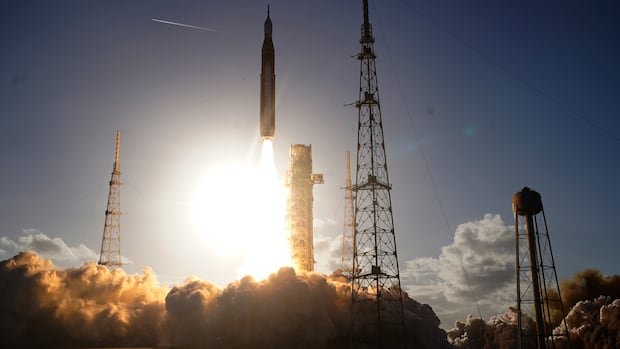

NASA’s Artemis program has been making headlines for its initiative to send astronauts on a mission around the moon. Beneath this mission lies a broader strategic objective: a new competition between the United States and China to land humans on the lunar surface.
This race goes beyond mere flag planting and footprints. The country that achieves this milestone first could gain a strategic edge in selecting prime locations for future lunar infrastructure, establishing technical standards, and shaping the next phase of space exploration.
During NASA’s recent Ignition event, officials underscored the urgency of the situation. NASA is aiming to return Americans to the moon before China, and notably before the end of President Donald Trump’s term in office.
Jared Isaacman, the billionaire appointed by Trump to lead NASA, emphasized the importance of timing, stating, “NASA has pledged to return Americans to the moon before the end of President Trump’s term, whereas our main competitor has set their target beyond 2030.” The margin between success and failure, he added, will be measured in months rather than years.
The race is now officially underway, at least in the political arena. While NASA is fast-tracking its plan to land Americans on the moon by early 2028, Wu Weiren, chief designer of China’s lunar program, has confidently stated that the Chinese people will set foot on the moon by 2030 without a doubt.
Casey Dreier, chief of space policy at the Planetary Society, remains skeptical about the feasibility of the 2028 deadline but acknowledges that China has become a significant motivator for NASA and its supporters.
This competition is envisioned as a marathon, not a sprint, contrasting with the past Apollo missions. The primary goal now is not just to visit the moon but to establish a sustained human presence there.
Dean Cheng, a leading expert on China’s space program, highlights that China’s track record of fulfilling its space ambitions lends weight to its 2030 target. This reliability sets China apart in the eyes of many analysts.
While some view this as a race, Kevin Olsen, a Canadian research fellow, perceives it differently. He argues that the U.S. will always hold the historical distinction of being the first to the moon. Additionally, Olsen notes that the Artemis program is a collaborative effort involving multiple countries, emphasizing a broader, more inclusive approach to space exploration.
The importance of the moon’s south pole in this race cannot be overstated. Both the U.S. and China have expressed interest in establishing lunar bases near this location due to its strategic value, including the presence of water ice in shadowed craters. Water on the moon could potentially serve as a vital resource for sustenance, oxygen, and fuel.
The urgency extends beyond politics and into the geographical realm. Securing prime sites near the moon’s south pole could offer a significant advantage to the first country to land there.
As the competition intensifies, the cadence of lunar missions becomes a crucial factor for long-term success. The country that establishes a sustained presence on the moon may influence future space exploration standards and regulations.
Funding remains a major challenge for NASA, as the agency looks towards private industry for support. The competition for lunar lander development has evolved into a race between two billionaire-led companies, SpaceX and Blue Origin, to provide the necessary spacecraft for lunar missions.
This modern space race is characterized by a complex interplay between national goals, international partnerships, and private sector involvement, contrasting sharply with the historical space race. For China, landing on the moon signifies more than just a technological feat; it’s a statement of capability and advancement.
Ultimately, the moon serves as a stepping stone for both the U.S. and China towards deeper space exploration, with Mars and beyond on the horizon.