
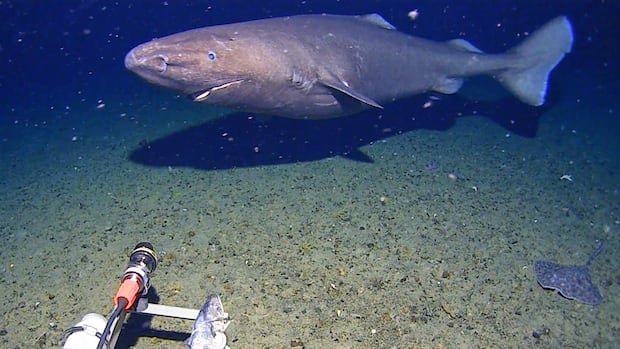

An unusual sight unfolded as a large, barrel-shaped shark leisurely glided across a desolate seabed in the deep, dark waters of Antarctica. This surprising encounter challenged experts’ beliefs that sharks were absent in the icy Antarctic region until a massive sleeper shark made a cautious appearance in front of a video camera in January 2025, according to researcher Alan Jamieson.
The remarkable footage captured by the Minderoo-UWA Deep-Sea Research Centre’s camera, positioned near the Antarctic Peninsula off the South Shetland Islands, revealed a shark estimated to be between three and four meters long. Jamieson expressed astonishment at the unexpected presence of such a robust shark in the Antarctic waters, describing it as a formidable creature, akin to a tank.
The shark, spotted at a depth of 490 meters with a bone-chilling water temperature of 1.27 degrees Celsius, shared the frame with an unmoving skate, a species known to inhabit these southern waters. The researchers, led by Jamieson, noted that this was the first recorded sighting of a shark in the Antarctic Ocean, raising questions about possible shifts in marine life patterns due to climate change.
Peter Kyne, an independent conservation biologist, confirmed the rarity of such a sighting, emphasizing the lack of historical records of sharks in this region. The researchers suggested that warming oceans and changing environmental conditions might be luring sharks towards the frigid Antarctic waters, although data on these shifts remains scarce due to the area’s isolation.
The footage of the sleeper shark cruising at a depth of approximately 500 meters along a sloping seabed captured the attention of marine experts, highlighting the mysterious depths of the Antarctic Ocean. Jamieson speculated that other shark species might inhabit similar depths, scavenging on the remains of deceased marine animals that sink to the ocean floor.
Given the challenging conditions and limited observation periods in the Antarctic Ocean, researchers stressed the significance of such rare encounters and the need for continued exploration during the brief Southern Hemisphere summer months. The discovery of the sleeper shark at these depths sheds light on the complex underwater ecosystem of Antarctica and the potential adaptations of marine life to this extreme environment.