
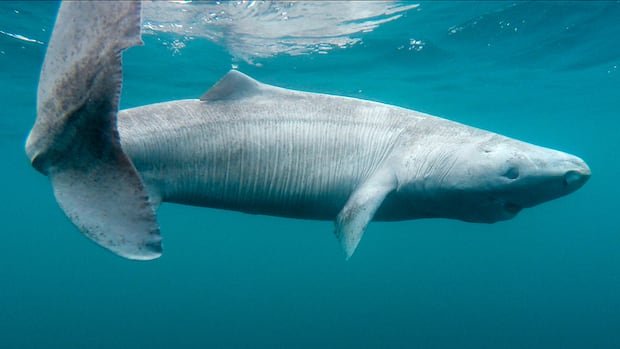

When zoologist Emma Murphy learned that a deceased Greenland shark had washed ashore in northwestern Ireland, she was astonished. These massive and ancient ocean creatures are known for their elusiveness and typically inhabit the remote depths of the Arctic and North Atlantic oceans.
Describing her excitement, Murphy, a zoology curator at the National Museum of Ireland, expressed disbelief at the rare occurrence. The museum highlighted the exceptional nature of the species’ presence in Irish waters, marking the first recorded stranding of a Greenland shark on Ireland’s coast.
While researchers in Ireland examine the remains of the shark, one scientist suggests that the species may have a wider distribution than commonly believed. The Greenland shark, renowned as one of the world’s largest carnivorous shark species, ranks second only to the great white shark. It typically reaches lengths of three to five meters but can grow up to seven meters, making it the longest-lived vertebrate on Earth with a lifespan exceeding 270 years.
Despite being primarily found in the cold waters of the Arctic and North Atlantic, including regions like Quebec and Atlantic Canada, shark expert Dean Grubbs notes that Ireland falls within the known habitat range of the Greenland shark. Grubbs explains that due to their large size and mobility, these sharks can traverse vast distances as long as the water temperatures remain cold, typically below 6 degrees Celsius. Researchers have even encountered Greenland sharks in unexpected locations such as Belize and the Gulf of Mexico, indicating a broader geographical presence.
Given their deep-sea habitat, Greenland sharks are rarely sighted by humans. Murphy and her team had a rare opportunity to observe one up close after its discovery on the Irish coast. Despite the challenges of reaching the shark’s location, they were exhilarated by the encounter, emphasizing the beauty of the creature.
Following the retrieval of the carcass with the help of volunteers and local authorities, the scientists are conducting further examinations to determine the cause of death. The shark, identified as a three-meter-long male approaching sexual maturity, is estimated to be around 150 years old. Despite its age, the shark appeared healthy with no apparent injuries or signs of malnourishment.
While the origin of the shark remains unknown, it will find its final resting place in Ireland. The researchers plan to preserve the shark’s skin and skull for public display in the National Museum of Ireland, ensuring that future generations can appreciate this remarkable specimen up close.