
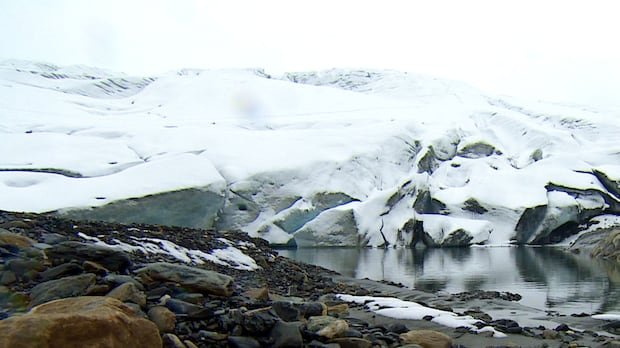

The year 2025 was designated by the United Nations as “The International Year of Glaciers’ Preservation.” However, a climate researcher in northern British Columbia has revealed that last year witnessed the second-highest level of glacier loss on record in western Canada.
Brian Menounos, an earth sciences professor at the University of Northern British Columbia and the chief scientist at the Airborne Coastal Observatory of the Hakai Institute, emphasized the inevitability of glacier disappearance. He noted that glaciers are vanishing at a much faster rate than previously anticipated due to factors like warmer temperatures driven by increased greenhouse gas emissions.
Menounos estimated that approximately 30 gigatonnes of glacial ice were lost in the region in the past year, equivalent to the volume of B.C.’s Okanagan Lake. This alarming trend is primarily attributed to rising temperatures and a lack of late summer snow, leading to reduced reflectivity on glacier surfaces and accelerated melting.
Menounos and an international research team have been monitoring global glacial health through satellite and aircraft observations and on-site sampling. Their recent peer-reviewed study highlighted unprecedented ice loss in Western Canada, the Conterminous U.S., and Switzerland between 2021 and 2024.
Glaciologist Mark Ednie from the Geological Survey of Canada echoed the widespread scientific consensus on glacial decline, emphasizing its adverse effects on the environment and economy. He warned that the loss of glacial ice could significantly impact water availability for various uses, such as industry and agriculture.
In British Columbia, home to around 17,000 glaciers, melting glaciers affect river levels critical for fish habitats and hydroelectric power generation. The federal and provincial governments have expressed commitments to combatting climate change, but the complex nature of the issue poses challenges to finding lasting solutions.
While government initiatives like the Climate Action Plan aim to reduce emissions while fostering economic growth, the expansion of fossil fuel projects raises concerns among researchers like Menounos. Balancing economic interests with climate preservation remains a pressing dilemma, highlighting the urgent need for sustainable policies to address the escalating threat of glacier loss.