
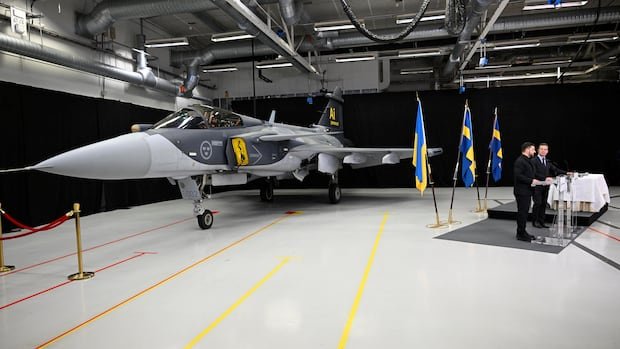

The Swedish defense company Saab is contemplating Canada as a potential location for assembling Gripen fighter jets in response to increased demand from Ukraine. Saab’s CEO, Micael Johansson, mentioned in recent interviews with financial media outlets that Kyiv’s interest in acquiring over 100 Gripen fighter jets would necessitate a doubling of the company’s production capacity. Reports from the Financial Times and Reuters indicated that Saab is exploring options to expand production capacity, potentially in Canada or other European locations.
During the Canadian Aerospace Summit in Ottawa, Industry Minister Mélanie Joly expressed enthusiasm about this development, describing it as positive news. She confirmed having discussions with Johansson earlier in the day, emphasizing the potential for enhanced partnerships between Saab and Canada, starting with the GlobalEye surveillance plane. The GlobalEye, a long-range surveillance aircraft, is a collaborative effort between Saab and Bombardier.
Simon Carroll, president of Saab Canada, highlighted the importance of the Canadian aerospace industry as a significant market to meet rising global demand. Carroll emphasized the company’s commitment to fostering relationships with Canadian firms to support various programs and products for both domestic and international markets.
Regarding Ukraine’s military interests, plans are underway to bolster its fleet with a mix of fighter aircraft, including F-16s, Gripens, and French Rafales. The Gripen jets are particularly favored for their ease of maintenance, road capabilities, and quick crew training. While Saab proposed building and maintaining Gripen jets in Canada previously, the contract went to U.S. manufacturer Lockheed Martin for the F-35 fighters.
A recent agreement between Sweden and Ukraine outlined the potential export of up to 150 Gripens to Ukraine, although a formal contract is pending. Ukrainian President Volodymyr Zelenskyy aims to expand the nation’s fleet to around 250 fighter aircraft as part of military modernization efforts.
In parallel, Canada continues to deliberate on the acquisition of 88 F-35 fighter jets, with Prime Minister Mark Carney initiating a review due to global trade tensions. The decision-making process involves a thorough evaluation to ensure the right choice for this significant investment. Minister Joly suggested the possibility of a mixed fighter fleet, considering both F-35s and Gripens.
The ongoing discussions reflect the complexities of military procurement decisions, balancing national security interests, economic benefits, and job creation opportunities. High-level engagements between Canadian officials and Saab executives underscore the strategic importance of these deliberations for Canada’s defense capabilities and industrial partnerships.