
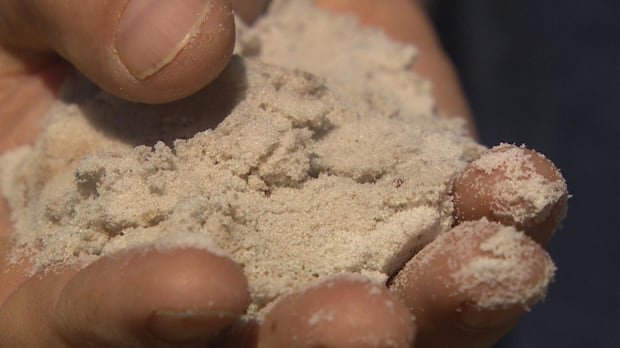

An Alberta-based company planning to mine silica sand in Manitoba has announced a collaboration with the largest university in the province for the development of a cutting-edge groundwater monitoring network. This initiative involves the utilization of advanced technology crucial for global groundwater research.
Carla Devlin, the president of Sio Silica, disclosed that the company will engage with the University of Manitoba to conduct a feasibility study and create a sophisticated, non-intrusive system capable of monitoring aquifer conditions in real-time. Devlin emphasized that the objective is not limited to their project but extends to enhancing responsible resource management practices across the province.
The partnership coincides with Sio Silica’s renewed efforts to extract sand from the sandstone aquifer beneath the Rural Municipality of Springfield in southeastern Manitoba. Previously, the NDP government rejected Sio Silica’s license application in 2024 due to concerns regarding potential impacts on water quality and underground stability.
Initially, Sio Silica proposed a plan involving drilling 7,200 wells east and southeast of Winnipeg over 25 years to extract silica sand used in various industries. However, community opposition arose over environmental fears, prompting Sio Silica to revise its strategy by reducing the number of wells and sand extraction volumes in their subsequent license application.
Devlin clarified that the collaboration with the university is distinct from their licensing endeavors but represents a significant step towards transparency in the project’s progression. She expressed confidence that the research project, aimed at comprehensively understanding the aquifer system, would address past apprehensions surrounding the license application.
The research project, termed a “game changer” by Sio Silica’s technology team, will investigate the southern Manitoba aquifer as a holistic entity, generating a comprehensive groundwater database. This data, according to Devlin, would be costly for the government to replicate and underscores the project’s value.
Ricardo Mantilla, an associate professor at the University of Manitoba leading the project, highlighted the use of quantum gravimetry to measure changes in the gravitational field as groundwater shifts. While this technology provides insights into groundwater quantities, it does not assess water quality. Mantilla emphasized the project’s significance for both Sio Silica and the larger provincial context, emphasizing the importance of understanding water dynamics for effective resource management.
Landon Halloran, a hydrogeologist and hydrogeophysicist, underscored the global adoption of quantum gravimetry for groundwater monitoring, citing NASA’s utilization of such technology. However, he noted limitations in spatial resolution for local assessments, making it more suitable for broad-scale applications.
Halloran suggested that gravimetry could potentially reduce the need for costly well drilling, aligning with Sio Silica’s objective to minimize well installations. He stressed the importance of safeguarding groundwater resources, emphasizing their critical role in the water cycle and as a primary source of drinking water.