
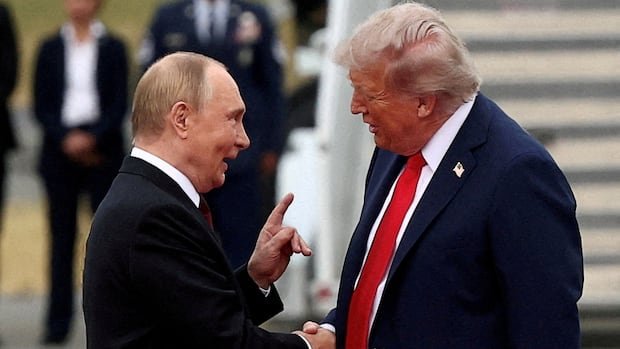

A scheduled meeting between U.S. President Donald Trump and Russian President Vladimir Putin has been postponed, with Moscow’s refusal to agree to an immediate ceasefire in Ukraine complicating negotiation efforts. A senior White House official informed Reuters that there are currently no arrangements for President Trump to hold talks with President Putin in the near future. This decision followed a “productive call” between Secretary of State Marco Rubio and Russian Foreign Minister Sergei Lavrov, who decided against an in-person meeting.
Despite Trump’s previous announcement that he and Putin would convene in Hungary to address the conflict in Ukraine, Moscow’s reluctance to make concessions has stalled progress. Russia has consistently insisted that Ukraine must concede more territory before any ceasefire can be considered.
While Trump expressed reluctance to engage in an unproductive meeting, he hinted at potential developments in the coming days. Kirill Dmitriev, Putin’s investment envoy, confirmed ongoing preparations for a summit in a social media post.
In a confidential communication known as a “non-paper,” Russia reiterated its stance on a peace agreement, emphasizing its demand for full control of the disputed eastern Donbas region. This stance contradicts Trump’s proposal for a ceasefire starting with a freeze of frontline positions.
European leaders have urged the U.S. to stand firm in demanding an immediate ceasefire in Ukraine, with existing battle lines serving as the foundation for future negotiations. NATO Secretary General Mark Rutte visited Washington for discussions with Trump, aiming to present European perspectives on the ceasefire and subsequent peace talks.
The Kremlin emphasized the need for thorough preparation before a summit can take place and clarified that no specific date has been set. The delay in a pre-summit meeting between Rubio and Lavrov in Budapest indicated that the U.S. may be hesitant to proceed with a Trump-Putin summit unless Moscow shifts its position.
Zelenskyy remarked on Russia’s decreased interest in diplomacy following the U.S. postponement of a decision on providing Tomahawk missiles to Ukraine. He reiterated the importance of starting talks from current battlefield positions, criticizing Russia for hindering diplomatic efforts.
European allies have expressed concerns that a second meeting between Trump and Putin could occur without significant concessions from Russia. They support Trump’s stance on an immediate ceasefire and using current battle lines as the basis for negotiations. Despite past fluctuations in Trump’s public statements on Ukraine, his recent endorsement of starting a ceasefire from existing positions has garnered support.
Zelenskyy viewed his meeting with Trump positively, highlighting the public support for a ceasefire at current lines. European leaders plan to meet with Zelenskyy to discuss a security force for postwar Ukraine. The choice of Budapest as a potential summit location raises EU concerns due to Hungary’s warm relations with Russia. Poland declared its readiness to intercept Putin’s plane, while Bulgaria indicated a willingness to allow Putin’s passage through its airspace.