
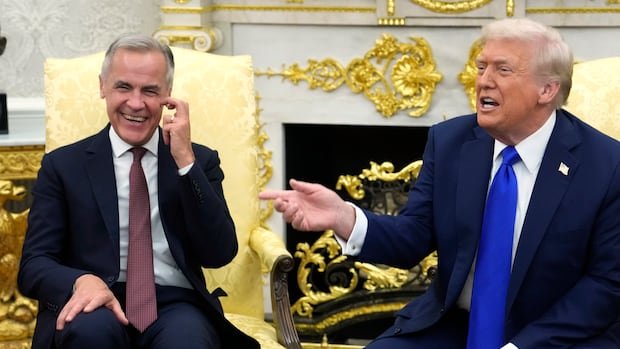

U.S. President Donald Trump expressed more favorable sentiments towards Canada on Tuesday than previously observed since his election victory last November. However, it remains uncertain whether this verbal shift will translate into tangible relief from the existing punitive tariffs.
In a meeting lasting 32 minutes in the Oval Office with Prime Minister Mark Carney, Trump emphasized the “mutual love” shared between the two nations, commended Canada’s efforts in combatting fentanyl, and praised Carney as a “very strong, very good leader.” Despite these positive remarks, they do not signify an immediate change in policy.
In contrast to his past criticisms of Canada’s trading practices, assertions that the U.S. does not depend on Canadian exports, and suggestions for Canada to join as the 51st state, Trump’s recent approach towards Canada appeared notably more amicable. Kelly Ann Shaw, a senior trade adviser to Trump, noted the encouraging tone in the interactions between Trump and Carney during the public segment of their meeting.
Flavio Volpe, the Canadian president of the Automotive Parts Manufacturers Association, also recognized the change in Trump’s rhetoric towards Canada, hinting at a potential elevation of Canada’s status as a competitor in his eyes.
Regarding the automotive industry specifically, Trump struck a more measured tone, highlighting the mutual interest in the success of both countries within the sector. While indicating collaboration in finding solutions, the actual impact on industries like auto, steel, aluminum, and lumber in Canada hinges on concrete policy adjustments rather than verbal gestures.
Despite the positive signals, the ultimate outcome remains uncertain. However, Trump hinted at ongoing discussions and potential developments. The meeting concluded with directives to expedite negotiations focused on steel, aluminum, and energy, as relayed by Canada-U.S. Trade Minister Dominic LeBlanc.
The evolving relationship between Trump and Carney, though significant in diplomatic circles, bears watching as personal ties can influence political decisions. Observers note Trump’s relational approach and the importance of establishing rapport for progress in negotiations.
The closed-door discussions culminated in a directive to swiftly pursue agreements on critical trade matters, indicating a potential shift in the stalemate over tariffs on steel and aluminum since their escalation in June. The Canadian trade team remains engaged in ongoing talks in Washington to navigate these complex trade issues.