
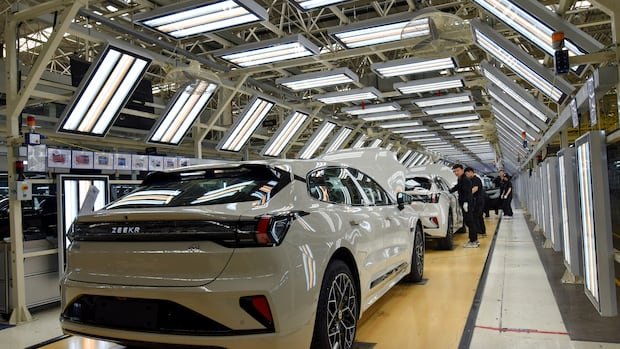

Seeking an eco-friendly and smooth driving experience, Sooren Moosavy, a 28-year-old resident of Baltimore, is interested in purchasing an affordable electric car in the U.S. However, his search has led him to consider Chinese automakers’ models, which are currently not easily accessible in the country.
Expressing his desire to test-drive options from BYD, Geely, and Zeekr due to their compact design, luxurious interiors, and competitive pricing, Moosavy reflects a growing trend among consumers looking for budget-friendly alternatives amidst the rising average cost of new vehicles in the U.S., nearing $50,000.
While Chinese electric vehicles have gained popularity in regions like Europe, Latin America, and Canada, they face significant challenges entering the U.S. market due to tariffs exceeding 100%, imposed by the government over concerns of data security and safeguarding American jobs.
Unlike the restrictions in the U.S., various Chinese EVs in Europe offer features like advanced driving assistance technology, a built-in mini fridge, and even the option to engage in karaoke with passengers, all at prices below $30,000.
China’s automotive industry has witnessed a remarkable export surge, surpassing Japan to become the world’s leading vehicle exporter. Recently, Canada agreed to reduce tariffs on an initial quota of 49,000 Chinese EVs annually, joining other countries welcoming these cars, including Mexico.
Although U.S. President Donald Trump has shown openness to Chinese automakers entering the American market under the condition of employing U.S. workers, resistance from major auto trade groups and political figures like Republican Senator Bernie Moreno of Ohio persists, citing concerns about competitiveness.
Amidst concerns over data security and protecting local businesses, surveys indicate mixed sentiments among U.S. consumers regarding the potential introduction of Chinese car brands. While some express interest in the affordability and innovative features of Chinese models, others raise apprehensions about safety standards and compliance.
Despite the obstacles, the allure of Chinese EVs remains strong, with a significant portion of U.S. consumers acknowledging the value proposition and expressing support for the presence of Chinese auto brands in the market. Notably, the affordability and efficiency of these vehicles attract consumers like Rich Benoit, who is contemplating purchasing a BYD model in Mexico for personal use in the U.S.