
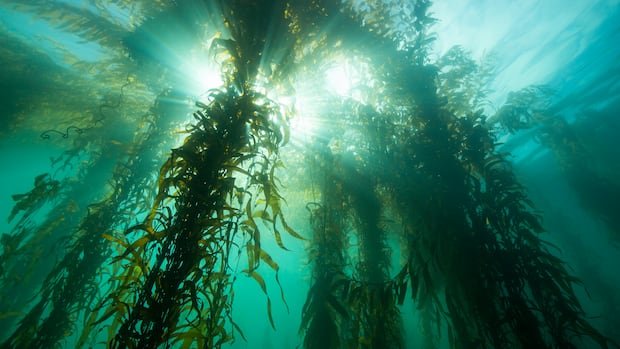

Near the Dallas Road breakwater in Victoria, the ocean harbors thriving kelp forests just below the water’s surface, benefitting from the cold temperatures. However, Brian Timmer, a doctoral student at the University of Victoria (UVic), noted that certain areas in British Columbia are experiencing localized warming, leading to the disappearance of once-dense kelp populations.
A recent study led by Timmer from UVic, published in Ecological Applications, analyzed historical data on kelp and associated macroalgae communities in the northern Salish Sea dating back to 1972. The research team compared this data with current imagery and surveys conducted in 2023.
The study revealed that expansive bull kelp forests, covering over 5.5 million square meters in the northern Salish Sea, particularly around the Comox and Denman Island region, have vanished. This loss is ten times greater than the previously established baseline around the year 2000. Satellite images show that the decline primarily occurred between 1972 and 1984.
Contrary to popular belief attributing the disappearance of B.C.’s bull kelp forests to recent heatwaves, Timmer’s research suggests that substantial losses occurred decades earlier. The study focused on a warm water pocket near Comox and Denman Island within the Strait of Georgia, where sea surface temperatures have risen by 0.25 C per decade over the past 50 years.
Kelp, regarded as a foundational species in marine ecosystems, plays a crucial role in supporting marine life by providing food and habitats. The decline in kelp and microalgae communities is linked to rising coastal water temperatures in British Columbia, according to Timmer’s findings.
William Cheung, a professor at the University of British Columbia, highlighted the importance of establishing accurate baselines to understand environmental trends effectively. Timmer, in collaboration with the Kelp Rescue Initiative and First Nations, aims to restore kelp forests by identifying suitable habitats and replanting kelp species.
The research emphasizes the urgency of conservation efforts to protect these vital marine ecosystems.