

This excerpt comes from The Buzzer, CBC Sports’ daily email newsletter. Keep informed on sports happenings by subscribing here.
With just eight days remaining until the formal commencement of the Winter Olympics in northern Italy and only six days until preliminary events kick off, excitement is palpable across Canada. At the forefront of public curiosity: How many medals will Canada secure? And which athletes will be the medalists?
To provide insights into these inquiries, we’ve once again collaborated with our partners from Shoreview Sports Analytics to analyze the data. Similar to their work on our Olympic curling and hockey forecasts, but on a broader scale, Shoreview has developed a statistical model aimed at forecasting the results of every event in the Olympics.
Without delving too deeply into the complexities of the calculations, this methodology involved evaluating the skill levels of every athlete or team based on past performances, followed by simulating each event 10,000 times to predict potential outcomes.
As is typical with statistical modeling, this process blends both art and science. For instance, how should one factor in injuries? How far back should historical results be considered? Is consistency more valuable than current form? These questions introduce a level of complexity.
Significant effort was dedicated to fine-tuning all these variables and more. Nevertheless, it’s crucial to acknowledge that even the most sophisticated models can’t predict everything. There will undoubtedly be surprises—both positive and negative. However, these forecasts offer a solid indication of what to anticipate from Team Canada.
Now, let’s get to the main content. Below are Shoreview’s anticipated medal standings, ranked by gold medals, which is the official ranking method used by the Olympics.
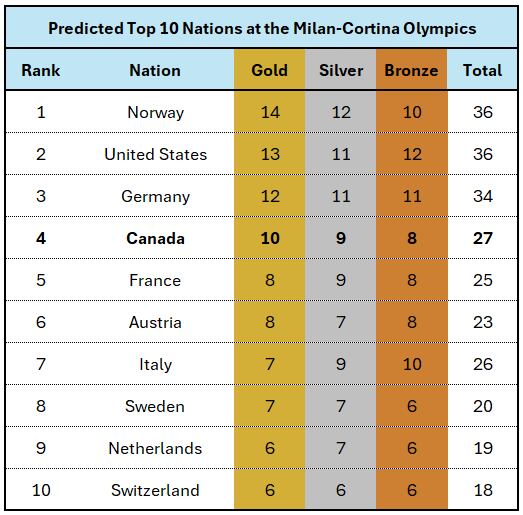
(Source: Shoreview Sports Analytics)
Here are the anticipated Canadian medalists:
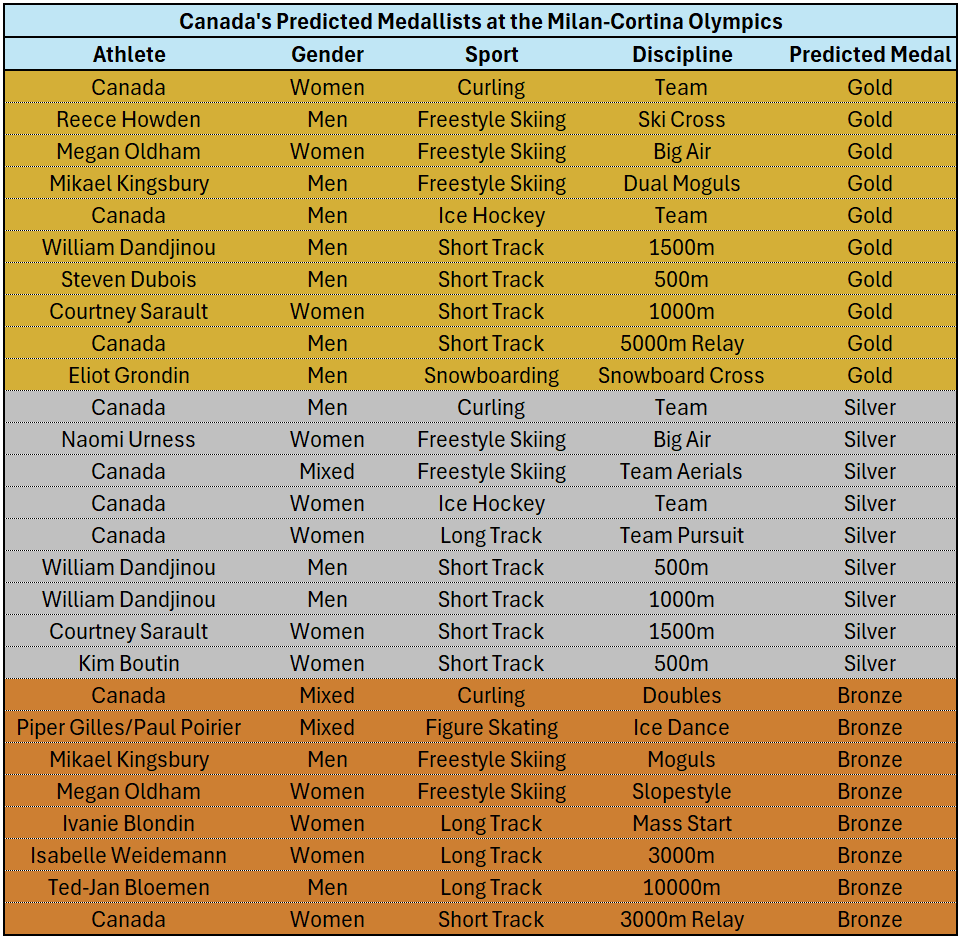
(Source: Shoreview Sports Analytics)
Next, let’s discuss some intriguing findings from these predictions, along with additional context.
Canada is projected to win 27 medals. Is that impressive?
Absolutely. This would mark the second-highest number of medals ever secured by Canada at the Winter Olympics, only behind the 28 medals achieved in 2018 in South Korea.
It’s worth noting that there are now significantly more opportunities for medals as the Olympics continues to introduce new sports and events. Still, Canada is keeping pace with other leading nations in total medal counts. If the forecast of a fourth-place finish holds true, this will signify the seventh consecutive Winter Olympics where Canada ranks either third or fourth in total medals.
At the previous Winter Games in Beijing 2022, Canada won 26 medals, but only four of those were gold (along with eight silvers and 14 bronzes), resulting in an 11th-place finish in the official ranking. Thus, achieving the forecast of 10 golds and a confirmed fourth-place finish this time around would represent a significant improvement.
This would also be only the third occasion that Canada has secured double-digit golds in Winter Olympics history. The nation won 11 in 2018 and 14 in 2010 in Vancouver, which remains the only time Canada has finished first in the official standings.
Hockey: Mixed fortunes
With NHL players returning to the Games for the first time since 2014, Canada is expected to clinch its third straight Olympic men’s “best on best” tournament. This would allow captain Sidney Crosby and defenceman Drew Doughty—both members of the 2010 and 2014 teams—to become the first non-Soviet athletes to win three Olympic men’s titles, much to the delight of numerous Canadian sports fans who prioritize the men’s hockey gold above all at these Games.
However, as highlighted in our Olympic hockey preview, this tournament may be more competitive than anticipated. Despite being the favorites, Canada’s projected odds of winning gold are only around 37 percent. Interestingly, the Shoreview model places Sweden next at 24.6 percent, surpassing the United States (21.5 percent), which is expected to face Canada in the finals after their intense encounters at last year’s 4 Nations Face-Off.
On the women’s side, it’s disappointing for Canada to be projected to relinquish its Olympic title to the United States, a strong favorite after their victory at last year’s world championship and a decisive sweep of Canada in this fall’s four-game Rivalry Series, with a total score of 24-7.
A resurgence in curling?
While Canada did secure the inaugural Olympic mixed doubles title in 2018, it hasn’t won gold in traditional four-player curling since 2014, managing only a single bronze medal across the four combined men’s and women’s tournaments since then. Anxious Canadian fans will be pleased to see that Rachel Homan’s women’s team, reigning back-to-back world champions, is predicted to break the gold-medal drought, while Brad Jacobs (the men’s Olympic champion in 2014) is forecast to take silver, and the mixed doubles pair of Jocelyn Peterman and Brett Gallant is expected to bring home bronze.
This scenario would allow Gallant to earn two medals in Italy, as he also competes as the second stone for Jacobs’ team, while Homan aims to redeem herself after missing the playoffs in the women’s event in 2018 and in mixed doubles in 2022.
However, a note of caution is warranted. Just like in men’s hockey, the competition will be fierce. According to our curling preview, the Shoreview model gives Canadian women a 42.5 percent chance of winning gold, with four-time world champion Silvana Tirinzoni of Switzerland (33.8 percent) posing a significant threat. On the men’s side, Canada has a better than 75 percent chance of winning a medal, but at 28.1 percent for gold, Jacobs trails behind the favorite, Bruce Mouat of Great Britain (49.4 percent). Mixed doubles is more uncertain, with Peterman and Gallant having nearly a 50-50 chance of medaling.
Piper and Paul!
One of the highlights of these projections is seeing the well-established ice dance partnership of Piper Gilles and Paul Poirier predicted to take home bronze. Canada did not secure a figure skating medal at the 2022 Olympics, the first instance of this since 1980, and who better to restore the country’s presence on the podium than this duo? Gilles and Poirier have earned medals at four of the last five world championships, including back-to-back silvers in 2024 and 2025 and a bronze in 2023 shortly after Gilles underwent treatment for ovarian cancer. This will be their third and likely final Olympics, making it a memorable opportunity for them to achieve their first medal.
Unfortunately, the pairs team of Deanna Stellato-Dudek and Maxime Deschamps is not projected to reach the podium. They achieved Canada’s first figure skating world title in six years back in 2024 in Montreal, but their performance has been inconsistent since then. The model gives them about a 40 percent chance of medaling, indicating that there is still hope.
Will Dandjinou is set to shine.
I’ve been emphasizing this point for months, so it’s gratifying to see the projections align with my views.
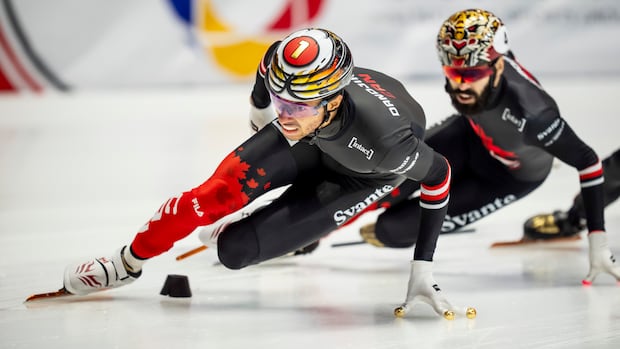
Dandjinou, 24, has excelled in short track speed skating over the past two seasons, securing back-to-back men’s overall titles on the World Tour and winning four golds and a silver at the world championships. He is now on the verge of becoming a household name in his Olympic debut, with Shoreview anticipating he will earn a Canadian-high four medals, including two golds. The model predicts he will medal in all three of his individual races (gold in the 1,500m; silvers in the 500 and 1,000) along with a gold in the men’s relay.
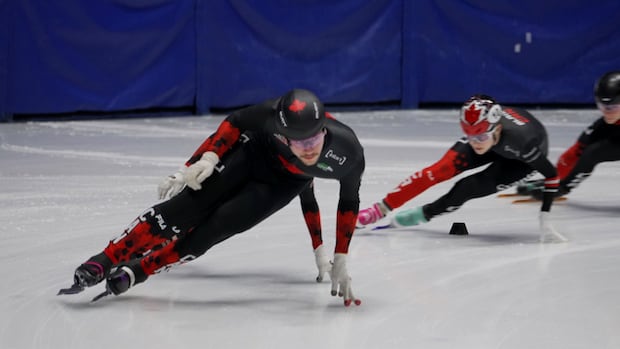
Canada’s short-track speed skating team held a practice in Montreal less than two weeks before the Winter Olympics kick off in Italy. Considered Canada’s strongest team in decades, the athletes are processing the growing pressure to win gold at Milano Cortina 2026.
Should Dandjinou win four medals, he would tie swimmers Summer McIntosh and Penny Oleksiak for the second-most medals ever won by a Canadian athlete at a single Olympic Games. Speed skater Cindy Klassen holds the record with five medals from 2006.
Close behind Dandjinou is Courtney Sarault, Canada’s leading female short tracker. She’s forecasted to secure a medal of every color: gold and silver individually, plus a bronze in the relay. Adding a men’s solo gold for Steven Dubois and a women’s silver for Kim Boutin, Canada is expected to tally nine medals (four of which are gold) in short track—its highest total in any sport. The model even predicts a Canadian medalist in every short track event except for the mixed relay, making this thrilling sport a must-watch.
Canada’s long track speed skaters are also anticipated to perform strongly, projected to win four medals, highlighted by a silver from the defending-champion women’s team pursuit trio of Ivanie Blondin, Isabelle Weidemann, and Valérie Maltais.
The moguls GOAT bids farewell at the top.
Mikaël Kingsbury has indicated that this may be his final Olympics, and he will have two opportunities to cap off his remarkable career with a gold, as the head-to-head dual moguls event makes its Olympic debut alongside the regular moguls. Kingsbury, 33, boasts an Olympic gold, two silvers, nine world championships, and a record 100 World Cup victories.
According to the Shoreview model, he is expected to take bronze in the men’s moguls on February 12, which would be somewhat disappointing but not unexpected, given that he has missed much of this season due to a groin injury. However, he is projected to win gold three days later in the dual moguls, providing a fitting Olympic send-off for the greatest moguls skier in history.
Joining Kingsbury in the spotlight is fellow freestyle skier Megan Oldham, forecasted to win gold in the women’s big air event and bronze in slopestyle. Canada’s seven anticipated medals in freestyle skiing also include a gold in ski cross for Reece Howden, the reigning World Cup champion and all-time leader in men’s wins.
Additionally, Canada is expected to have the projected men’s snowboard cross champion in Éliot Grondin, who is the current world champion and back-to-back World Cup title holder. This would mark the 24-year-old’s third Olympic medal after securing silver in the men’s event and bronze in the mixed team competition in 2022.