
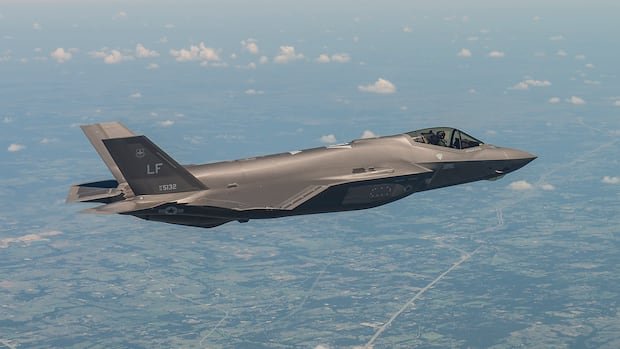

The F-35, a fighter jet manufactured in the United States, outperformed the Swedish Gripen in a recent competition organized by the Defence Department in 2021. The assessment focused on the ability of each aircraft to defend the North American continent and carry out diverse military missions effectively against modern adversaries.
The F-35 received a high score of 95% in military capabilities, totaling 57.1 out of 60 points. In contrast, the Gripen-E scored only 33%, earning 19.8 points out of 60, as per the Department of National Defence (DND) ranking disclosed by Radio-Canada. Notably, the gap between the two aircraft was particularly noticeable in terms of “mission performance” and the potential for aircraft upgrades throughout their lifespan.
The Defence Department declined to provide detailed comments on the competition scores but mentioned that the review process for the F-35 acquisition is still ongoing. The substantial superiority of the F-35 over the Gripen could potentially explain the Canadian government’s decision to reconsider its 2015 pledge against purchasing the F-35, according to David Perry, the president of the Canadian Global Affairs Institute.
Experts, including Justin Massie from the Université du Québec à Montréal, highlighted the systematic inferiority of the Gripen compared to the F-35 in military capabilities. Former Royal Canadian Air Force lieutenant-general Yvan Blondin emphasized the unmatched advantages of the F-35 in terms of stealth and integration of military data from various sources.
While Saab, the manufacturer of Gripen, lauded its aircraft as adaptable and designed for swift upgrades, Lockheed Martin, the maker of the F-35, emphasized that its aircraft remains the best choice for Canada. The Canadian government has placed an initial order for 16 F-35s, with discussions ongoing regarding the potential acquisition of a mixed fleet that would include Gripens assembled domestically.
Lockheed Martin has committed to over $15 billion in benefits over the contract’s lifetime, stating that each jet will have significant Canadian content. However, the economic benefits could diminish if Canada reduces its F-35 order quantity, as indicated by the company. The decision to procure a mixed fleet will be crucial for Canada’s long-term military strategy, considering both current and future needs in the evolving landscape of air combat.