
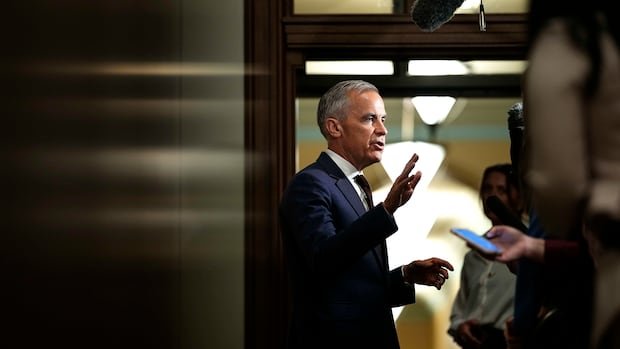

Prime Minister Mark Carney stated that the Canadian economy is undergoing a significant transformation driven by his government’s response to the U.S. trade war. He acknowledged that the recent downturn into a technical recession is partly due to the economy’s adjustment phase. Carney emphasized that his government has been laying the groundwork for a more robust and independent Canadian economy through substantial investments and operational changes.
Recent data from Statistics Canada revealed a 0.1% decline in real GDP on an annualized basis in the first quarter, following a more substantial contraction in the previous quarter of 2025. While this consecutive decline meets the technical definition of a recession, some economists and the Bank of Canada have advised against overemphasizing this news.
Carney highlighted measures taken by the government to address economic challenges, such as reducing immigration to stabilize population growth and curbing the pace of government spending growth. He noted a shift from nearly 10% growth in government spending to less than 2% currently.
BMO chief economist Douglas Porter attributed the economic weakness in the first quarter to an unexpected drop in government spending and investment. He pointed out challenges like declining exports and business investment, influenced by trade uncertainties. Despite these hurdles, Carney expressed optimism about increased investments in machinery, equipment, intellectual property, and research and development in recent months.
Household incomes have been on an upward trend, outpacing inflation, but Carney acknowledged the need for further progress. The prime minister asserted that the new economic foundation is taking shape, paving the way for a more resilient economy.
Porter commended moderate consumer spending growth in the first quarter but cautioned against downplaying the recession’s impact. Bank of Canada’s senior deputy governor Carolyn Rogers suggested a potential economic rebound in April despite the technical recession status. Scotiabank’s chief economist Derek Holt disputed the recession label, citing factors like weather conditions and trade fluctuations.
Holt highlighted positive indicators such as strong consumer activity and early signs of economic recovery in the second quarter. He warned against premature recession declarations based on isolated factors like increased gold imports. Carney’s critics, including Conservative Leader Pierre Poilievre, have criticized the government’s handling of the recession, pushing for a reversal of economic policies. Poilievre has been vocal about the recession’s implications, contrasting Canada’s economic performance with other G7 nations.
The ongoing debate surrounding Canada’s economic status reflects differing perspectives on the recession’s severity and the government’s response to economic challenges.