
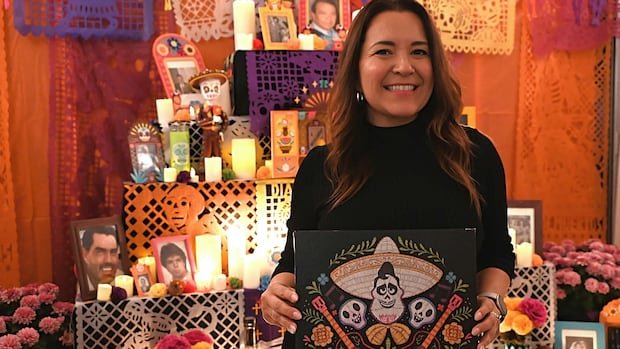

This year, Karla Frey faced challenges completing her traditional ofrenda at her residence in Boucherville, Quebec. The difficulty stemmed from the tragic car accident that claimed the lives of her five-year-old neighbor and his mother two months ago. The young boy was a regular visitor who showed interest in Frey’s ofrenda, a tribute she has been setting up for 15 years to honor departed loved ones.
Despite the heavy emotions surrounding the mother and son’s passing, Frey persevered and assembled her altar, adorning it with picture frames, candles, symbolic bread called pan de muerto, papel picado, mezcal, tequila, and Mexican marigolds known as cempasúchil. Reflecting on the boy’s love for life, Frey dedicated a part of her ofrenda to him and his mother, finding solace in completing the tribute.
El Día de Muertos, or Day of the Dead, a revered multi-day celebration in Mexico from late October to early November, holds deep cultural significance. It involves commemorating deceased relatives, friends, children, and even pets by reminiscing, celebrating, and embellishing graves, cemeteries, streets, and homes with vibrant decorations.
In Quebec, the Mexican community upholds these ancestral customs. For Frey, who hadn’t observed Día de Muertos while residing in Mexico City, the festival serves as a poignant link between her Quebecois life and her Mexican heritage.
Dealing with the concept of death through memories of life, Frey annually hosts friends at her home to share tales of their departed loved ones. She places mezcal, water, and tequila on her altar, believing the departed are thirsty upon their visit. Guided by the scent of copal incense and photographs, the spirits find their way to the altar. Frey emphasizes the importance of remembering the deceased, as failing to do so means they perish again, this time from oblivion.
Expressing her emotions through the ofrendas over the years has aided Frey in coming to terms with her father’s passing, serving as a means of emotional exchange and visual representation of loss.
After participating in Day of the Dead festivities for years, Gerardo Familiar Ferrer’s experience celebrating the holiday with Indigenous friends in Oaxaca, Mexico, transformed his understanding and reverence for the tradition. Familiar Ferrer’s altar in Gatineau, Quebec, includes names of departed loved ones, including his maternal grandmother, showcasing his profound grasp of the customs and his commitment to sharing Día de Muertos with others.
In recent days, numerous individuals have gathered at UNAM-Canada in Gatineau to partake in an immersive journey exploring Día de Muertos. The guided tour, set up like a dimly lit cave, symbolizes an essential element of Mexican traditions, emphasizing the significance of caves and caverns as connections between the living and the afterlife.
The tour, running until November 8, epitomizes Mexican Quebecers’ dedication to sharing their cultural heritage with a broader audience. Another example is Rafael Benitez, a Montrealer and co-founder of PAAL Partageons le monde, who organizes Montreal’s Día de Muertos festival. Benitez sees the festival as a cathartic outlet for his grief and a means of fostering intercultural dialogue and understanding in the community.
Every edition of the festival highlights the resilience of Indigenous peoples in preserving ancestral traditions, with the participation of groups like the Comcáac in Mexico and the Kanien’kehá:ka. Benitez underscores the importance of acknowledging the past struggles of these peoples to sustain these traditions for present and future generations.
Despite the festival’s themes of death and remembrance, participants emphasize that Día de Muertos is not intended to evoke fear. It serves as a day of reflection, gratitude, and joyful celebration of the memories shared with departed loved ones. Karla Frey, embodying this sentiment, conveys her vibrant energy and love for life through her meticulously curated ofrenda</em, intending to show her daughters the same love and respect when her time comes.
The festival continues to evolve as a platform for cultural exchange and collective remembrance, fostering unity and understanding among diverse communities in Montreal.