
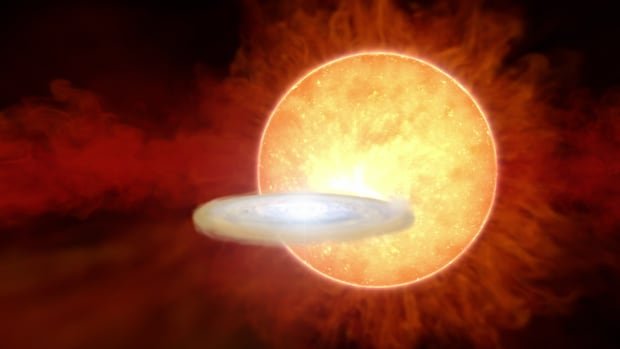

In April 2024, the highly anticipated astronomical event was the total solar eclipse visible in Eastern Canada and the U.S. The potential appearance of a new star in the sky, T Coronae Borealis, was also generating excitement. This star, commonly known as T Cor Bor, was projected to become visible to the naked eye by the end of the year.
However, contrary to expectations, there was no significant bright new star in the sky. Brian Kloppenborg, an astrophysicist and executive director of the American Association of Variable Star Observers (AAVSO), mentioned the ongoing uncertainty surrounding the physics of the T Cor Bor system despite extensive studies.
Located approximately 3,000 light years away, T Cor Bor is part of a binary system within the Corona Borealis constellation, consisting of a large red giant and a dense white dwarf star. The interaction between these stars involves material transfer from the red giant to the white dwarf, leading to a potential nova explosion and a visible brightening of the star every 80 years.
Historically, there have been periods of heightened activity followed by a return to a low state before an eruption, with the last one occurring in 1946. Despite various predictions suggesting imminent eruptions, the exact timing remains uncertain.
Recent research forecasts possible eruption dates, including several in the upcoming years. While some studies propose a potential delay in the expected cycle, the interest in T Cor Bor remains high among amateur astronomers who continue to observe and provide valuable data.
When T Cor Bor erupts, it is expected to brighten significantly for a brief period before dimming again. The star’s visibility will increase from being barely perceptible to the naked eye to a magnitude easily observable with binoculars. The continuous monitoring and observing efforts aim to capture the anticipated event when it occurs.
In conclusion, the fascination with T Coronae Borealis persists, as astronomers eagerly await its eruption, expecting it to occur in the near future.