
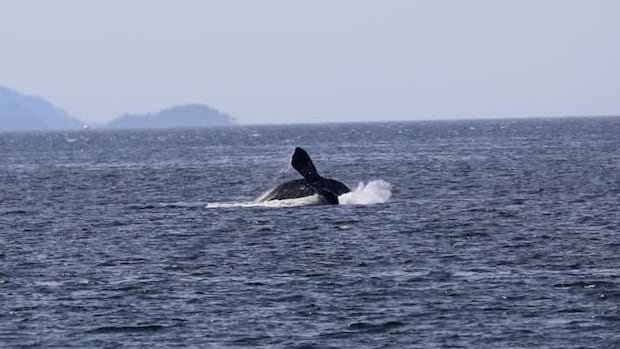

Troy Bright, a seasoned whale researcher stationed off Malcolm Island, had an extraordinary encounter last Sunday. While observing the waters, he witnessed a whale breaching multiple times, a sight he had never seen before. Pulling out his camera, Bright, who has dedicated 30 years to documenting whales with Bere Point Research, captured images of the unique whale.
Identifying distinct features of the whale, Bright noted its short, black pectoral fins, distinguishing it from humpback whales. Experts, including Bright and other cetacean specialists, confirmed the whale as an endangered North Pacific right whale, known to be the rarest and most endangered whale species globally.
Jared Towers, a cetacean research technician with the Department of Fisheries and Oceans (DFO), embarked on a search mission for the whale, emphasizing how easily it could have been missed if not for its peculiar behavior of rolling with a piece of kelp on the surface.
The juvenile North Pacific right whale, measuring approximately eight meters long, spotted off Malcolm Island, is a significant discovery. Only seen seven times in British Columbia, this whale belongs to the most critically endangered whale population in Canada, with fewer than 50 individuals remaining.
Researchers view the sighting as a positive sign for the small whale population, suggesting a potential calf sighting after many years. Despite the lack of knowledge regarding their birthing grounds, experts are encouraged by the recent observations and are keen to learn more about these elusive creatures and their feeding habits.
The North Pacific right whale’s unique “gunshot calls” and singing behavior have been studied using sonobuoys, with recent detections off Langara Island near Haida Gwaii. The recent sighting has sparked interest among researchers, with Kevin Campion from Save the North Pacific Right Whales expressing excitement and highlighting the species’ historical challenges due to human activities.
Acknowledging the species’ historical exploitation and current threats, researchers emphasize the need for conservation efforts to protect these majestic creatures. The hope is to unravel more about their feeding patterns and habitat to enhance conservation strategies and safeguard vital areas for their survival.