
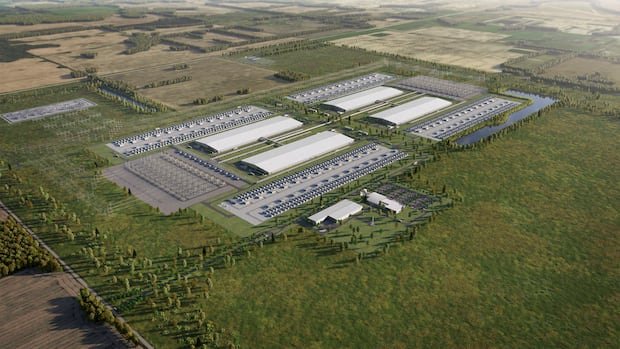

New York made history by halting the expansion of hyperscale data centers, making it the first state in the U.S. to do so. Governor Kathy Hochul, a Democrat, emphasized her commitment to taking a proactive stance by issuing an executive order that suspends the issuance of new permits for large data centers for a period of one year.
This decision has thrust New York into a larger conversation regarding the regulation of these massive data centers that power artificial intelligence. The discourse has extended to Canada as well, with companies eyeing expansions in the country while some local communities express concerns about the strain on their power grids and water resources.
In Hamilton, Ontario, a similar moratorium was being considered but was ultimately rejected by the city council. The surge in data center developments, as noted by Anne Pasek, a Trent University associate professor specializing in data centers, underscores the need for more robust public engagement in the approval process.
The scrutiny surrounding data centers stems from their role as facilities that house computing infrastructure like servers and storage drives. Particularly, hyperscale data centers, characterized by their substantial scale with thousands of servers and tens of thousands of square feet, have drawn attention for their environmental footprint.
These data centers support not only AI but also cloud computing services that people interact with daily on platforms like social media and streaming services. Approximately 20% of data center energy consumption is attributed to AI, a figure expected to rise as the demand for computing power surges, fueled by significant investments by tech giants in infrastructure to support AI technologies.
The exponential growth of the AI industry has raised environmental concerns, with data centers consuming a significant amount of energy and water resources. The cooling systems used in these facilities, particularly evaporative cooling, contribute to water usage concerns, although they are designed to be energy-efficient. Despite data centers’ substantial water consumption, industries like irrigation still consume far more water globally.
Infrastructure challenges arise as data centers cluster together, impacting neighboring communities with issues such as noise and air pollution. The strain on local power grids during peak seasons is another critical concern, as highlighted by instances where data centers were asked to switch to backup power sources to alleviate pressure on public electricity grids during heatwaves.
While the U.S. leads in data center development, Canada has emerged as an attractive destination due to its cost-effective electricity. Meta’s recent announcement of a massive data center near Edmonton underscores the country’s growing appeal for data center investments. Canada currently hosts five hyperscale data centers, with more in the pipeline, according to research from York University.
As the debate around data centers intensifies, provinces and territories in Canada have varying stances on implementing moratoriums. Alberta, a significant hub for data center capacity, emphasizes responsible investment, acknowledging the need for thorough assessment of the impacts on electrical grids and water supplies. Other regions like Manitoba and Quebec have different perspectives on data center development, citing economic considerations and environmental sustainability.
Each province and territory is approaching the issue based on its unique circumstances and priorities, with considerations ranging from job creation to environmental impact and energy sustainability. The evolving landscape of data center regulation in Canada underscores the complexities and challenges associated with balancing technological advancement with environmental responsibility.