
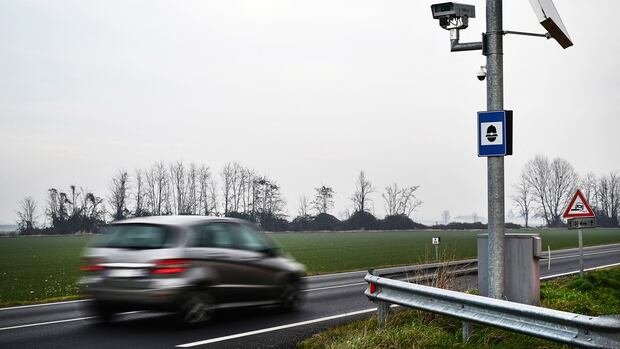

In a small town near Padua, Italy, on a winter day in 2024, commuters woke up to a surprising sight: a speed camera vandalized with an angle grinder, displaying the message “Fleximan is coming.” Following numerous similar attacks on speed cameras, the name Fleximan has garnered a legendary status in Italy.
Tom Roper, an English school proprietor residing in the region for 15 years, describes Fleximan as a local hero, with people frequently inquiring about him. Despite the flashy vigilante actions of Fleximan, there is a widespread consensus throughout Europe that speed cameras are effective and widely supported.
Jenny Carson, a project manager at the European Transport Safety Council (ETSC) in Brussels, notes that there is substantial public backing for enforcement measures to reduce speeds. Italy, boasting over 10,000 operational speed cameras, the highest number in Europe, provides evidence of this trend. A 2018 European survey revealed that nearly 70% of Italians favored stricter speeding regulations, even though almost half admitted to speeding in the previous month.
Contrary to Ontario Premier Doug Ford’s stance against speed cameras, labeling them a “cash grab” and considering a ban, Europe has successfully cultivated broad public support for automated enforcement to potentially save thousands of lives annually. France serves as a prime example, where President Jacques Chirac prioritized reducing traffic fatalities following a series of high-profile accidents in 2002, leading to the installation of over 2,400 speed cameras in the country.
Laurent Carnis, a traffic safety expert at France’s Université Gustave Eiffel, emphasizes the necessity of political commitment to establish and sustain a comprehensive enforcement system. France’s approach includes utilizing both fixed and mobile speed cameras for educational and punitive purposes, resulting in a significant decrease in average speeds and road accidents across Europe.
While speed cameras have shown promising outcomes in Canada, with reported speed reductions around camera locations, experts caution against potential drawbacks. Immediate reductions in speeding rates could lead to a focus on minor offenses, contributing to growing opposition, as seen in France where vandalism of speed cameras has reached alarming levels.
Experts recommend selective and transparent deployment of speed cameras, targeting outliers and ensuring speed limits are logical before implementation. Despite challenges and opposition, advocates like Roper in Italy continue to support speed cameras as a necessary measure to control reckless driving behavior.