
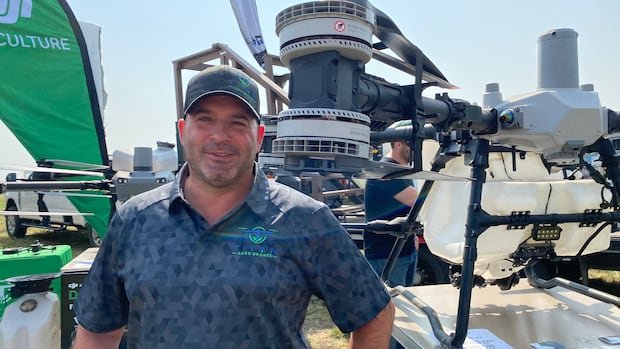

Last year, salesperson Ryan Crumly had foreseen that farmers would eagerly embrace drone technology once it was permitted to use them for spraying insecticides and fungicides on crops. His prediction seems to have come true. In late June, Health Canada removed its restrictions, allowing drones to spray approved pesticides. This change triggered a surge in demand for the technology, according to Crumly, who is employed at Titan Aero Drones. “I’ve never been so inundated with inquiries,” he remarked. “We had nearly 80 drones in stock, and they sold out within days.”
Both farmers and drone vendors have applauded the policy alteration, citing the superior effectiveness of drones over traditional ground sprayers and planes. Anticipation is high for a substantial increase in the adoption of pesticide-spraying drones, with numerous farmers expressing intentions to purchase one in the near future.
Pesticide-spraying drones are lauded as an innovative technology with several advantages. Unlike planes and helicopters that are restricted to daytime operations and struggle near trees and power lines, drones offer more flexibility, as highlighted by Crumly. This year, some farmers expressed specific interest in drones due to challenges faced by ground sprayers getting stuck in muddy conditions caused by flooding.
According to Crumly, drones are user-friendly, allowing farmers to plan the spraying route and method, after which the drone can operate autonomously for the most part. “You’re essentially just overseeing the process by changing batteries and refilling the tank,” Crumly explained.
Greg Hill, a farm and ranch operator in southeast Saskatchewan, envisions drones making a significant impact in agriculture. He pointed out that even with narrow tires, ground sprayers can damage 22 to 24 acres of crops while working, potentially resulting in substantial losses. Drones, on the other hand, eliminate this issue, making the investment worthwhile in a relatively short time.
Although the initial cost of spray drones can be tens of thousands of dollars, they are a cost-effective alternative compared to high-priced ground sprayers, which can run into hundreds of thousands, as per Crumly. Additionally, operational expenses are significantly lower, with drones costing about 83 cents per acre compared to $10.50 per acre for high-clearance ground sprayers.
Despite the cost considerations, farmers like Hill and Raymond Phillips of Alberta are closely monitoring advancements in drone technology. They acknowledge the additional expenses beyond the purchase price, such as the need for mixing systems, generators, and pilot licenses. Phillips expressed optimism about acquiring a drone within the next few years, emphasizing that while the technology is still evolving, it holds promise for the future of agriculture.