
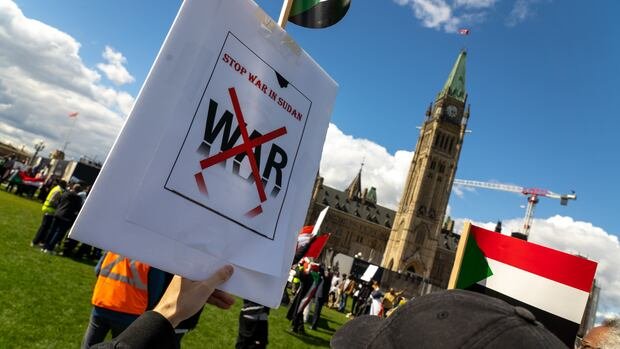

Despite Sudan’s paramilitary agreeing to a proposal from the United States and Arab powers for a humanitarian ceasefire on Thursday, members of Toronto’s Sudanese community express feeling abandoned by the Canadian government amid escalating violence in Sudan.
Rebel forces gained control of the Sudanese city of El Fasher on Oct. 26 after an 18-month siege, resulting in reports of extortion, rape, and mass killings of civilians.
In response to the crisis, Mamoun Hassan, a Sudanese Canadian filmmaker residing in the Greater Toronto Area, conveyed to CBC Toronto that his community believes Canada has not taken sufficient action to address the humanitarian crisis.
“We feel really, really betrayed,” he stated. “We feel like we’ve been misled about this country: that Canada values us as a people. It has become clear that this is not the case.”
The civil war in Sudan, labeled by the United Nations as the most significant humanitarian crisis globally, commenced in April 2023. It principally involves a conflict between the Sudanese Armed Forces (SAF) and the paramilitary Rapid Support Forces (RSF). Following the RSF’s takeover of El Fasher, there have been accounts of widespread killings in the city, leading tens of thousands of Sudanese civilians to flee the region.
Toronto-based Sudanese Canadians like Iman Abbaro express their sorrow over the situation. “Unfortunately, the sorrow is not new,” she remarked. “It’s been a lot of sorrow, but it’s layered.”
Abbaro also believes that the Canadian response has been inadequate. “The Canadian government should uphold Canada’s reputation as supportive of refugees and immigrants and facilitate Sudanese individuals seeking asylum to come to Canada,” she urged.
The Canadian government has implemented immigration, passport, and citizenship initiatives, such as enabling Sudanese nationals already in Canada to extend their stay and launching a family reunification program that allows some Sudanese nationals to acquire permanent residency through family sponsorship.
However, Hassan feels these measures are insufficient. He perceives that Canada’s response to other refugee groups, such as those from Afghanistan, Syria, and Latin America, was more prompt and accessible.
“This shouldn’t even be about immigration,” Hassan remarked, stressing that all individuals should be treated humanely during crises. The York University Sudanese Student Association issued a statement to CBC Toronto advocating for coordinated humanitarian assistance.
In a statement to CBC Toronto, Jeffrey MacDonald, communications advisor for IRCC, highlighted Canada’s ongoing concern over the Sudan conflict and the tailored responses provided to those needing support.
The statement mentioned that the government increased the number of family sponsorship applications processed, but clarified that new applications under the family-based permanent residence pathway for individuals affected by the Sudan conflict are not being accepted currently.
Ismail Kabar participated in a peaceful protest in Nathan Phillips Square to raise awareness and demand a stronger international humanitarian response. Having immigrated to Toronto from Darfur a decade ago, Kabar expressed concern for his cousin in El Fasher, whom he has not heard from since the city’s takeover.
As many protest attendees have relatives affected by the violence in Sudan, Kabar urged Canadians to contribute to humanitarian aid efforts. “I ask Canadians, if they could help, anything,” he appealed. “There’s some trusted Canadian NGOs that are here. They have offices in Darfur. They operate there. Anything, that would be very, very helpful, so that these people can actually go back to their lives.”