
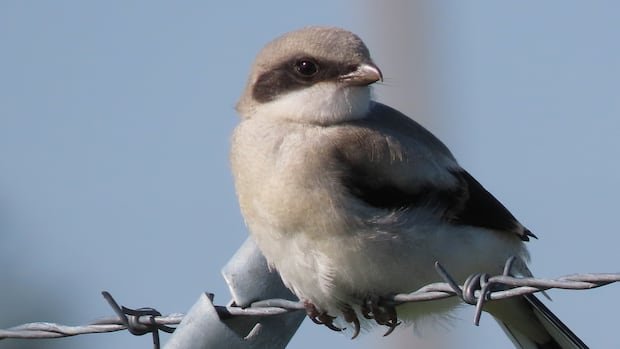

Perched delicately with soft feathers and a plump appearance, songbirds reveal striking white patches on their grey and black wings when in flight.
Yet, during their feeding ritual, these seemingly gentle creatures transform into merciless predators. Loggerhead shrikes, also known as “butcher birds,” prey on insects, rodents, and amphibians, impaling their catch on thorns or barbed wire before devouring them.
These shrikes, a threatened species predominantly found in Saskatchewan’s Prairies, are facing a decline in suitable habitats, as noted by wildlife advocates.
During a summer sighting near his office, Saskatoon birder Kerry Hjertaas, 42, observed shrikes in action.
Recalling a specific incident, Hjertaas described how a shrike landed on the barbed-wire fence beside his parked car, impaling its prey while another shrike joined in the feast.
“They tore into it voraciously, swiftly consuming the prey,” Hjertaas recounted. “Seeing this behavior firsthand was truly fascinating.”
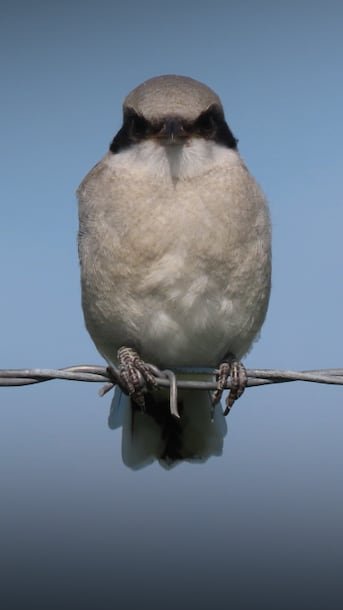
The unique hunting technique of impaling prey on thorns is attributed to shrikes’ lack of talons due to their songbird classification, explained Emily Putz, the habitat stewardship co-ordinator of Nature Saskatchewan’s shrubs for shrikes program.
Putz emphasized that shrikes are the sole species in Saskatchewan exhibiting this particular predatory behavior.
“Their distinctive behaviors make shrikes a captivating bird to observe in action,” Putz remarked.

An endangered species
Approximately 40,000 shrikes remain in Saskatchewan, noted Putz, underscoring their status as a threatened species, one level below being classified as endangered.
Habitat destruction poses a significant threat to shrike populations, according to Putz.
Native prairies serve as vital nesting and hunting grounds for these birds, yet only about 13% of Saskatchewan’s native prairies remain. Consequently, shrikes have adapted to utilizing shelterbelts, which are rows of shrubs encircling fields.