
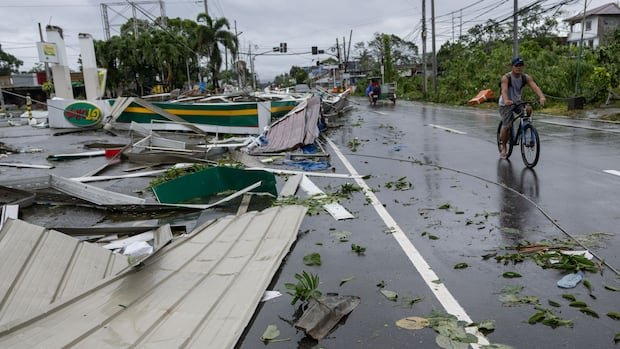

Typhoon Fung-wong has departed from the northwestern Philippines after causing floods and landslides, resulting in power outages across entire provinces. The storm led to at least eight fatalities and the displacement of over 1.4 million people. Its trajectory is now projected to move northwest towards Taiwan.
Fung-wong struck the northern Philippines amidst recovery efforts from Typhoon Kalmaegi’s impact, which claimed 224 lives in central provinces before hitting Vietnam. Making landfall in northeastern Aurora province as a super typhoon, Fung-wong carried sustained winds reaching 185 kilometers per hour, with gusts up to 230 kilometers per hour.
The storm weakened as it traversed mountainous northern regions and agricultural areas, eventually dissipating over the South China Sea. Tragic incidents were reported, including drowning in flash floods in Catanduanes, house collapse casualties in Catbalogan city, and landslides in Nueva Vizcaya and Mountain Province.
Emergency measures were taken, with over 1.4 million people evacuated and around 318,000 individuals housed in evacuation centers. The region experienced severe flooding in 132 villages, leading to significant property damage and residents stranded on rooftops.
President Ferdinand Marcos Jr. declared a state of emergency due to the severe impact of Kalmaegi and anticipated destruction from Fung-wong, also known as Uwan in the Philippines. The classification of cyclones with winds exceeding 185 kilometers per hour as super typhoons underscores the gravity of extreme weather events in the Philippines.
While the country has not requested international aid post-Kalmaegi, offers of assistance from the United States and Japan were noted. School closures, flight cancellations, and travel disruptions were implemented, with precautionary measures in place as the Philippines braced for the aftermath of consecutive typhoons.
The Philippines, prone to frequent natural disasters, faces an average of 20 typhoons annually, alongside seismic activities and volcanic eruptions, solidifying its status as one of the world’s most disaster-prone nations.