
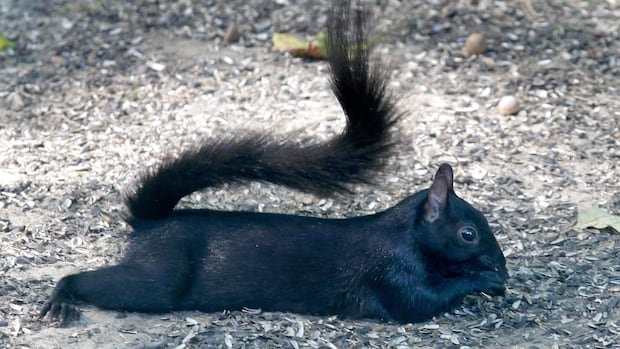

Francis Quang-Hai Dinh’s initial summer at McGill University involved exploring Montreal’s various parks on his bicycle in search of squirrels. He meticulously observed and documented over 800 grey and black squirrels across nearly 200 green spaces stretching from Mirabel to Saint-Bruno. What began as a university assignment evolved into a personal mission to investigate how the city’s urban layout and meandering water systems impact evolution discreetly.
Dinh, who is now pursuing integrative biology at the University of Illinois Urbana-Champaign, became the sole researcher known to conduct a comprehensive manual survey of squirrels park by park throughout the region due to the absence of a car and limited public transportation in suburban zones.
His research unveiled that approximately 12% of squirrels in Montreal don black coats, with a higher prevalence of black squirrels observed as he ventured northward. In regions just beyond Laval, the proportion of black squirrels soared to 40%. Conversely, on the island of Montreal, approximately 15% were black, while on the south shore, the figure plummeted to a mere two to three percent. This disparity was primarily attributed to temperature variation, as the cooler northern climates favored black squirrels due to their enhanced heat absorption capabilities.
Furthermore, forest density played a significant role, with denser tree canopies providing a darker backdrop where black squirrels could camouflage better. The study’s principal investigator, Allison Roth, an assistant professor at the University of Missouri and former McGill postdoctoral fellow, emphasized that the research focused on using squirrels as a model to examine how urban landscapes stimulate evolutionary alterations.
Roth highlighted the unique environmental diversity within cities, such as Montreal’s distinct neighborhoods, varying tree cover, and natural boundaries like the St. Lawrence River and its tributaries, which create micro-environmental fluctuations fostering genetic and physical adaptations in animal populations.
The study, titled “Fine-scale spatial variation in eastern grey squirrel melanism across a complex urban landscape,” diverges from previous research by scrutinizing wildlife changes at a neighborhood level rather than comparing urban versus rural settings. It challenges the notion that human development solely drives these transformations, showcasing that cities constitute only a fraction of the evolutionary puzzle. Urban expansion impacts local temperatures, reduces tree coverage, and introduces natural barriers like river systems.
The findings of the study, part of a special ecological feature across five scientific journals, underscore the indirect influence of urbanization on melanism, mediated by local vegetation structure and winter microclimates. Dinh expressed a newfound perspective on wildlife, highlighting the coexistence of urban environments and natural habitats despite human modifications.