

Anthropic is preparing for a significant stock market launch, featuring a substantial valuation, considerable expenditures, stark warnings, and notable uncertainty for investors, serving as a potential signal of the performance of the volatile artificial intelligence industry by 2027.
In a revised regulatory submission made on Tuesday, Anthropic, headquartered in San Francisco, indicated an anticipated price range for its initial public offering (IPO) between $70 US and $78 US per share. This projection suggests a fully diluted market valuation of approximately $1.3 trillion US at the midpoint, reaching $1.4 trillion US at the upper limit, which would represent the largest tech stock market launch ever.
Greg Taylor, a portfolio manager at Vancouver’s PenderFund Capital Management, remarked, “This is poised to be one of the largest IPOs in history.”
The magnitude of an IPO is generally assessed by the capital raised, and Anthropic aims to secure as much as $64.4 billion US from its public share offering. Should this goal be achieved, it would follow only SpaceX’s record-breaking stock market debut in June.
Anthropic is expected to commence trading on the Nasdaq exchange next week, with a listing notice indicating its debut is scheduled for Nov. 19. Nevertheless, the firm has not yet confirmed a date in its filings with the U.S. Securities and Exchange Commission (SEC).
Ernest Wong, the head of research at Toronto’s Baskin Wealth Management, believes the stock will be a formidable player when it begins trading on Nasdaq.
“There are only a few stocks globally valued at over $1 trillion US,” he stated. “This underscores the magnitude of AI.”
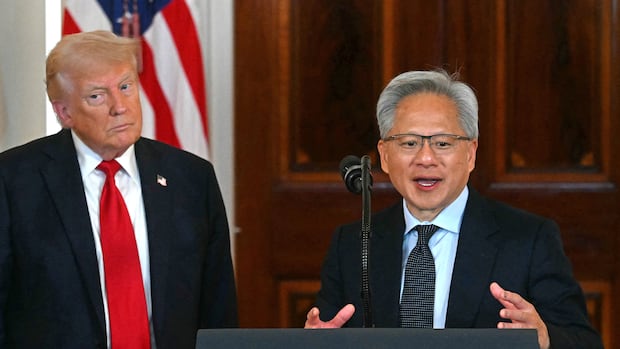
After Nvidia CEO Jensen Huang admitted to having an affair with an alleged Chinese spy, questions are being raised about the company’s governance and deeper implications for the future of AI.
What is Anthropic?
Founded in 2021, Anthropic began as a specialized AI research organization when its founders departed from OpenAI, feeling that the latter was overly profit-driven, neglecting risks, and granting excessive control to investors.
The company gained traction in 2024 with the launch of Claude 3.5 Sonnet, which outperformed OpenAI’s GPT-4o in critical performance metrics while being significantly more cost-effective than previous leading AI models.
-
OpenAI scraps release of new AI model over safety concerns
-
BMO, CIBC, RBC, TD Bank block personal AI agents, citing safety and security
-
FRONT BURNER
Will Anthropic’s IPO go boom or bust?
In contrast to Apple or Microsoft, Anthropic operates as a public benefit corporation, which legally obligates its board to consider public safety alongside maximizing shareholder profits.
Currently, CEO Dario Amodei is a prominent proponent of AI safety, urging the industry to decelerate development to allow safety protocols to catch up.
In its latest SEC filing, 94 of over 300 pages were devoted to detailing an extensive array of risk factors.
The company noted, “Our AI models may exhibit unintended, misaligned, or autonomous behaviors, potentially leading to harmful actions that neither users nor third parties have initiated.”
Anthropic cautioned that this could entail “conduct resembling blackmail or attempts to sway human decision-makers to ensure the model’s ongoing functionality,” along with actions that “could present catastrophic or existential threats to humanity.”
Big numbers
The projected valuation of $1.4 trillion US is not the only striking figure related to Anthropic’s IPO.
In recent months, the company’s valuation has seen significant fluctuations. A valuation of $2 trillion US was recently considered. In late May, private investors pegged the firm’s value at $965 billion US, a rise from $380 billion US in February.
According to Taylor, “There’s a considerable amount of optimism embedded in these valuations as they emerge.”
He added, “No one can accurately predict what Anthropic will look like in five years.”

Dario Amodei, CEO and co-founder of Anthropic, participates in the annual meeting of the World Economic Forum in Davos, Switzerland, in January 2025. (Markus Schreiber/The Associated Press)
The company has witnessed robust sales. Based on regulatory documents, Anthropic generated over three and a half times the revenue in the first half of 2026 compared to its total revenue for the previous year. Approximately 20 percent of these earnings were derived from two major unnamed clients.
Simultaneously, the AI titan has incurred significant losses. It reported a net loss of $80.7 billion US this year through June, primarily attributed to non-cash accounting entries. The company also recorded a loss of $42 billion US in 2025.
Anthropic has ambitious spending objectives as well. The firm does not construct or possess physical data centers; it instead leases high-performance computing capabilities from cloud service providers like Amazon Web Services and Google Cloud under extensive multi-year contracts.
As per regulatory documents, Anthropic has secured nearly $900 billion US in cloud and computing agreements extending into the 2030s and 2040s, collaborating with partners including Broadcom, SpaceX AI, Google Cloud, Amazon Web Services, and Microsoft Azure.
A blockbuster IPO
The significance of Anthropic’s IPO extends beyond its sheer size.
Taylor mentioned, “Investing in the Anthropic IPO represents one of the first pure-play AI ventures available.”
Previously, investors aiming to capitalize on the AI surge have mainly been limited to less AI-centric tech stocks like Microsoft or Nvidia, a chip manufacturer. While Google is considered part of the AI investment narrative, it also has extensive businesses that are not AI-related, such as its Android smartphones and YouTube.
Wong pointed out, “The sole focus of Anthropic is developing new AI models. This fills a significant gap, as public company data from various AI players is available, but not from the model developers, which primarily includes Anthropic and OpenAI.”
If Anthropic’s IPO is perceived as a new standard for AI investment, its early trading days will occur amid substantial fluctuations in the tech sector.
Earlier this month, technology and AI stocks faced dramatic sell-offs and rapid recoveries as the markets experienced corrections. This was partly due to worries over whether AI firms could balance their extensive expenditures with adequate profits. Political uncertainties in the U.S. following the midterms regarding tighter AI and data center regulations further complicated the landscape.
Additionally, the recent controversy surrounding Nvidia CEO Jensen Huang’s alleged connection with a suspected Chinese spy introduces a new layer of concern for AI investments. Nvidia’s stock, regarded as a barometer for AI trading, has seen billions in market value wiped out in recent days on the Nasdaq, where Anthropic is preparing to launch.
Like the dot com bubble?
Wong noted, “The primary risk for Anthropic lies in its need to compete with other model providers in a highly competitive landscape. OpenAI creates its own models, while SpaceX via Grok is a prominent model laboratory. Google and Meta are also active competitors in this arena.”
He anticipates that the stock will not be suitable for the faint-hearted initially, as investors will scrutinize each new Anthropic product in comparison to its competitors and assess its substantial spending on data services.
“It will be quite volatile,” Wong predicted.
Similar volatility has been observed with SpaceX since its Nasdaq launch in June. The stock rose about 19 percent on its first day but has since fallen as much as 22 percent below its IPO price of $135 US.
For Taylor, the massive expenditures in the AI sector, rapid stock price increases, and close business ties among a few tech firms all echo a past investment craze that starkly distinguished winners from losers.
He commented, “The dot-com bubble is certainly the most vivid example for many.” In 2000, there was a widespread desire to invest in the internet.
While some companies like Pets.com failed, giants like Google and Microsoft emerged as household names.
Taylor concluded, “There are many significant parallels with AI today. The challenge lies in determining who will ultimately prevail.”