
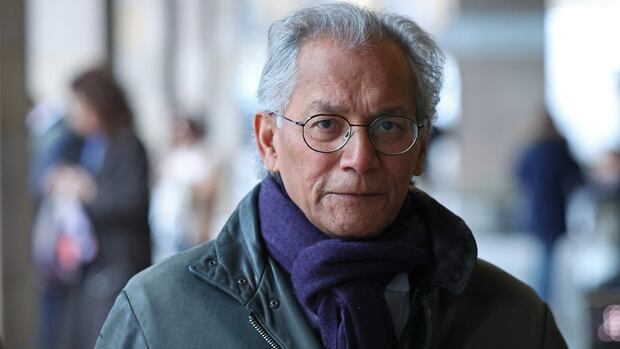

On Monday, the chairman of the BBC admitted that the organization was slow to react to accusations of bias stemming from a misleading edit of a speech by U.S. President Donald Trump. However, he dismissed assertions that the impartiality of the British broadcaster was being compromised by its own board members.
Top leaders at the BBC were questioned by the U.K. Parliament’s Culture, Media and Sport Committee during a significant crisis at the publicly funded entity, following the resignations of its director general and head of news earlier this month, alongside Trump’s threat to file a billion-dollar lawsuit.
The BBC attracted Trump’s criticism—and significant public attention—after a confidential memo from a former external adviser was leaked to the British press.
This memo highlighted instances of alleged biased reporting regarding a documentary about Trump that aired just days before the 2024 U.S. presidential election, along with other BBC coverage covering topics such as transgender issues, Gaza, and race.
Chairman Samir Shah expressed that the broadcaster should have responded much more swiftly to the allegations.
The external production company responsible for the documentary—titled Trump: A Second Chance?—combined three quotes from Trump’s speech delivered on January 6, 2021, into a single quote that seemed to suggest Trump was urging his supporters to march with him and “fight like hell.”
This editing created the impression that Trump was explicitly inciting his supporters to storm the U.S. Capitol while Congress was preparing to certify Joe Biden’s victory in the 2020 election. Shah acknowledged that the documentary gave “the impression of a direct call for violent action.”
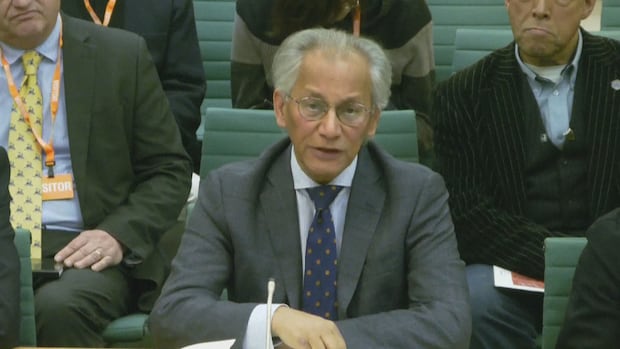
BBC chair Samir Shah faced a parliamentary grilling on Monday over the handling of a misleadingly edited speech by U.S. President Donald Trump, acknowledging the broadcaster should have responded more quickly. Michael Prescott, the former BBC adviser who penned the leaked memo that triggered the crisis, said he believed the BBC had ‘systemic’ issues, but he didn’t think it was ‘institutionally biased.’
“I think there’s an issue regarding our response time… why do we take so long?” he remarked to lawmakers on Monday. “We should have pursued this to the end and uncovered the truth, rather than waiting until it became a matter of public debate.”
Last week, the BBC indicated that Shah had reached out to the White House with a letter expressing regret for the speech edit. However, the broadcaster maintained that it did not defame Trump and rejected the grounds for his lawsuit threat.
Accusations of Political Interference
On Monday, Shah also defended board member Robbie Gibb, a non-executive director of the BBC’s board, who has faced intense scrutiny due to his past role as the director of communications for former Prime Minister Theresa May’s Conservative government.
Critics have accused Gibb of exhibiting pro-Conservative Party bias and interfering politically at the BBC.
“I think I’ve become a target in terms of public perception,” Gibb stated.
-
BBC director, head of news resign after criticism of Trump speech edits
-
BBC apologizes to Trump but rejects basis for his billion-dollar lawsuit threat
He dismissed allegations that insider actions within the BBC board led to the resignations of senior news executives as “utter nonsense.”
Just last week, Shumeet Banerji, another BBC board member, announced his resignation over “governance issues,” raising further concerns regarding the corporation’s leadership.
When asked if his own position was at risk, Shah stated that his focus was on “steering the ship” and finding a new director general.
Critics Highlight ‘Blind Spot’ at BBC
Earlier, during the parliamentary session, lawmakers directed inquiries at editorial standards brought up by Michael Prescott, a former journalist and external editorial standards adviser for the BBC.
Prescott authored an internal memo to BBC management that raised concerns regarding the editing of Trump’s speech and other instances perceived as indicative of left-leaning bias at the broadcaster. He claimed that BBC reporters promoted a pro-trans agenda and warned of an anti-Israel bias within the BBC’s Arabic service.
The Daily Telegraph published this memo in early November, igniting the current crisis.
In October, the BBC faced sanctions from Britain’s media regulator for a “materially misleading” documentary about children in Gaza, as it failed to disclose that the father of the teenage narrator had a role in the Hamas administration. The regulator stated that the program could potentially damage trust in the broadcaster.
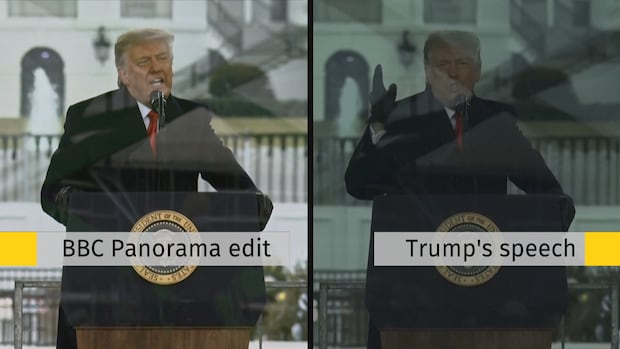
This side-by-side comparison shows the BBC-edited and original footage from a speech by U.S. President Donald Trump in Washington, D.C., on Jan. 6, 2021. Critics accuse the British broadcaster of editing the speech in a way that makes it appear he encouraged the subsequent U.S. Capitol attack.
Prescott stated that he believed the BBC was facing “systemic” challenges in addressing the issues raised and characterized the organization as defensive and dismissive of reported concerns about its journalism.
He remarked that ex-BBC director general Tim Davie and other management figures had a “blind spot” regarding editorial shortcomings. Nonetheless, he conveyed to lawmakers that he did not believe there was “institutional bias” within the broadcaster.
The 103-year-old BBC is under much more scrutiny compared to other broadcasters and commercial competitors due to its status as a national institution funded by an annual license fee of £174.50 ($230) paid by every household that watches live television or any BBC content. The broadcaster is required by its charter to maintain impartiality.
Legal experts have indicated that Trump would likely encounter difficulties in pursuing legal action against the BBC’s documentary in either the U.K. or the U.S., arguing that the BBC could prove that Trump was not harmed, given that he ultimately won the presidency in 2024.