
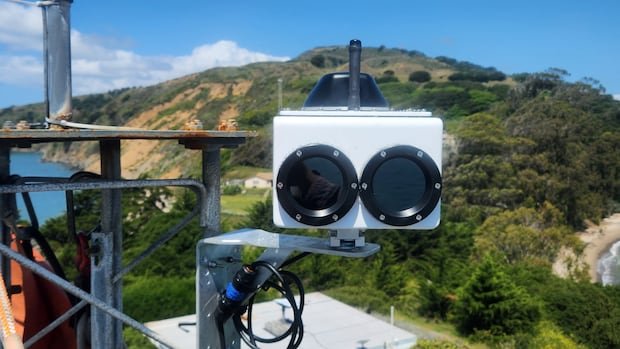

Marine scientists in British Columbia are exploring a new method for tracking whale sightings, inspired by a successful initiative in California. In San Francisco Bay, researchers, ferry operators, and the public are collaboratively using an innovative approach to monitor whale movements. By employing WhaleSpotter cameras, which utilize thermal imaging technology to observe whale activity round the clock, data on whale sightings is collected and shared through a public app.
Daniel Zitterbart, the lead scientist at WhaleSpotter, emphasized the importance of increasing surveillance in the water to enhance whale protection. While similar cameras are also operational in British Columbia, they are currently only land-based, limiting their range to about two nautical miles. These surveillance efforts are crucial for understanding whale migration patterns and mitigating the risk of vessel strikes, a growing concern in British Columbia as evidenced by recent incidents involving humpback whales and orcas.
In California, the WhaleSafe app serves as a platform for scientists, mariners, researchers, and the public to access and contribute to whale sighting data. This collaborative effort aims to build a community resource for public service, as highlighted by Douglas McCauley, the director of the Benioff Ocean Science Laboratory.
Thomas Hall from the San Francisco Bay Ferry expressed optimism about the potential of ferry-mounted cameras to track whale behavior and establish long-term patterns for route adjustments. Advocating for the adoption of similar technology on B.C. Ferries, Zitterbart emphasized the need to protect whales along their migration routes, particularly the humpback highways traversed by the ferries.
Efforts to prevent whale strikes are gaining momentum globally, with a focus on increased collaboration and data sharing among conservation groups. The rise in ship traffic and climate change impacts have underscored the urgency of safeguarding whale populations. Researchers in California have observed a rise in grey whale sightings, with a significant percentage showing signs of ship strikes.
Conservation biologist Sean Brillant stressed the urgency of addressing vessel strikes as a significant threat to whales, emphasizing the necessity for coordinated action across borders. Recognizing the global nature of the issue, Brillant highlighted the importance of sharing data and fostering cooperation among various stakeholders for effective conservation efforts.