
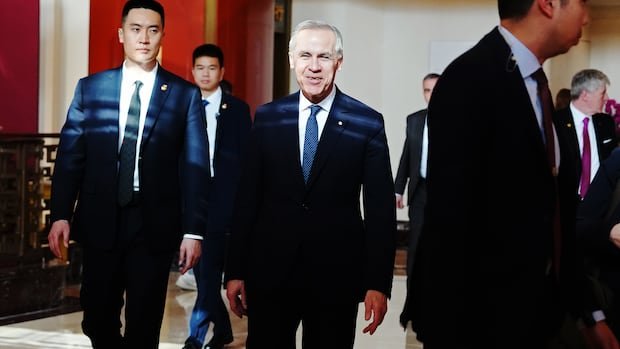

On the first day of discussions between Prime Minister Mark Carney and officials in Beijing, the Canadian government and China agreed to enhance collaboration in clean and traditional energy sectors following a history of strained relations. However, an ongoing tariff dispute remains unresolved between the two nations.
The newly established non-binding energy agreement signifies the commencement of high-level ministerial discussions, which have not occurred for nearly a decade according to a senior Canadian official. Despite this agreement, Beijing did not make any commitments to increase purchases of Canadian petroleum and liquefied natural gas (LNG) as outlined in the memorandum of understanding signed by Energy and Natural Resources Minister Tim Hodgson.
Hodgson stated that Chinese officials expressed a desire for more Canadian products. The memorandum of understanding, which expands on a previous accord, highlights discussions on oil and gas resource development, LNG, liquified petroleum gas, and emission reduction strategies.
Prime Minister Carney’s visit to China aims to move past years of diplomatic tensions with Beijing and aims to double non-U.S. exports over the next decade. The Prime Minister is anticipated to meet with China’s President Xi Jinping on Friday.
Despite the positive developments, there is no indication of progress in resolving Beijing’s retaliatory tariffs on Canada’s agricultural sector, including canola. Canadian officials have refrained from disclosing their strategies to reach a resolution.
Furthermore, Canada and China signed an economic and trade co-operation “road map” on the same day to enhance trade relations following years of diplomatic challenges. The agreement includes plans to increase Canadian pet food exports to China, boost tourism, and uphold existing pacts, such as combating crime.
Industry Minister Mélanie Joly expressed optimism about the new partnership with China, emphasizing a new era of collaboration. Carney acknowledged efforts made in recent months to establish a foundation for a strategic partnership between Canada and China, aiming to navigate the evolving global landscape effectively.
During the visit, Li, China’s Premier, conveyed the country’s willingness to enhance communication and trust with Canada, positioning Carney’s visit as a pivotal moment in bilateral relations. While negotiations are ongoing, there are expectations for a potential resolution to the agricultural tariffs issue.
Saskatchewan Premier Scott Moe accompanied Carney to Beijing for discussions, raising hopes for a potential agreement. However, negotiations are still in progress, as emphasized by Joly and Anand, who highlighted the productive nature of talks aimed at persuading China to reduce tariffs on the agricultural sector.
In anticipation of the visit, a Canadian official, speaking anonymously, expressed hopes for progress in addressing China’s tariffs perceived as unfair. Carney’s mission to China is part of a broader initiative to mend diplomatic tensions and boost non-U.S. exports over the next decade.
Carney engaged in various meetings with business leaders, including Contemporary Amperex Technology, a significant Chinese company specializing in electric vehicle batteries. Discussions regarding potential Chinese EV production in Ontario and tariff reductions are ongoing but have not been disclosed by officials.
The Prime Minister also met with Zhao Leji, chairman of the standing committee of the National People’s Congress, who affirmed China’s readiness to advance the strategic partnership with Canada. Carney expressed optimism about the swift progress in bilateral relations and underscored the potential for Canada and China to become strategic partners in energy and societal connections.