
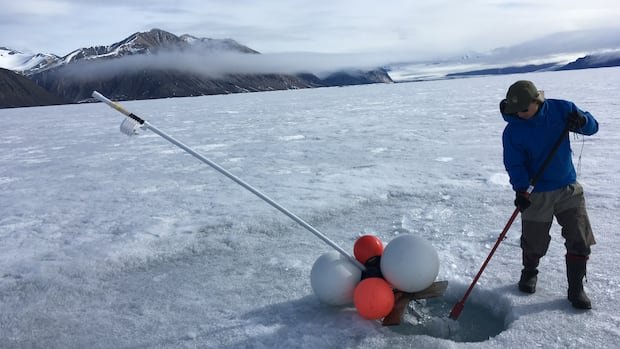

In a recent study, researchers have confirmed the disappearance of Canada’s last remaining epishelf lake, the Milne Fiord epishelf lake on Ellesmere Island in Nunavut. This unique freshwater lake floating on saltwater supported a distinct ecosystem that has now been lost. Lead author Jérémie Bonneau, an assistant professor at Laval University, expressed sadness over the vanishing of this rare natural feature, emphasizing its significance as the final one of its kind in Canada.
The study, recently published in the journal Scientific Reports, delves into the mechanisms behind the lake’s demise, attributing its irreversible loss to the impacts of a warming climate. The complete disappearance of the Milne Fiord epishelf lake, which had existed for over 4,000 years, marks a significant shift and signifies the end of an era according to the researchers.
Epishelf lakes form as a result of natural damming processes, such as the one caused by the Milne Ice Shelf blocking the mouth of the Milne Fiord for millennia. The freshwater layer, less dense than saltwater, accumulated on top of the Arctic Ocean’s saltwater, creating a unique floating layer shielded by a thick ice cover year-round. This distinctive environment allowed for the coexistence of separate freshwater and saltwater ecosystems within the same water column, a phenomenon not found elsewhere.
The lake’s disappearance was triggered by the 2020 collapse of the Milne Ice Shelf, which had held the lake in place. Subsequently, the freshwater drained rapidly into the surrounding saltwater fiord, leading to the immediate demise of the lake’s inhabitants. The loss of the epishelf lake highlights the ongoing transformations in the Arctic due to climate change and serves as a stark reminder of the fragility of unique ecosystems on Earth. Although epishelf lakes no longer exist in Canada, similar features can still be found in Greenland and Antarctica, albeit facing an uncertain future in the changing global climate landscape.