

In less than a fortnight, Cortina d’Ampezzo will welcome numerous athletes and spectators for the start of the Olympic Winter Games amid chilly conditions. However, a recent analysis by Climate Central reveals that compared to seven decades ago when the town previously hosted the event, temperatures have risen by over three degrees on average.
Following the 1956 Winter Games, February temperatures in Cortina were around -7 degrees Celsius. Fast forward to the period between 2016 and 2025, temperatures have surged to -2.7 degrees Celsius, indicating a substantial warming trend, as noted by Kristina Dahl, Climate Central’s vice president for science.
Leveraging a global temperature dataset dating back to the 1940s, Climate Central also identified a significant decrease in the number of days per year with temperatures below freezing in Cortina. This shift underscores the importance of maintaining naturally cold and snowy conditions for optimal competitive environments, especially for athletes.
Moreover, the report highlights the changing climate impact on the Winter Paralympics over the past five decades. Data shows that March temperatures in Cortina and Milan have increased by 2.5 and 2.1 degrees Celsius, respectively, since 1976, potentially affecting the competition conditions for the Paralympic athletes.
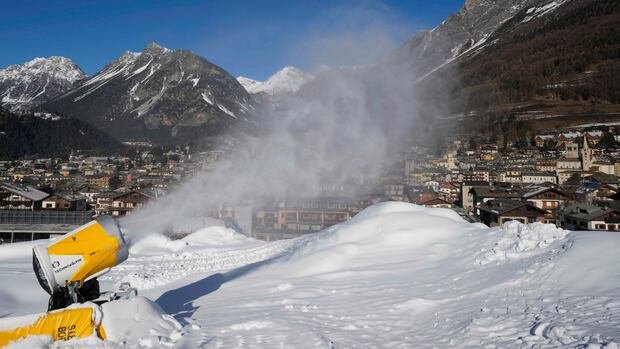
As climate change, largely fueled by fossil fuel consumption, continues to exert pressure on outdoor events, there is a growing reliance on artificial snow production. This dependence extends beyond the competition venues to encompass safety and runoff areas, reinforcing the need for adequate snow cover.
Recent concerns raised by International Ski Federation president Johan Eliasch regarding the artificial snow requirements at Livigno, the venue for freestyle skiing and snowboarding events, underscore the ongoing challenges posed by fluctuating weather conditions. However, recent improvements in temperature conditions have helped alleviate some of these concerns.
Ensuring the reliability of snowpack is crucial for the safety of athletes, particularly in high-speed events like women’s downhill skiing. The significance of sufficient and stable snow cover is emphasized by climate scientist Daniel Scott, who cites the potential risks associated with inadequate snow conditions, as observed during the 2014 Sochi Paralympics.
Looking ahead, the viability of future Winter Olympics is being scrutinized in light of climate change impacts. A study co-authored by Scott and commissioned by the International Olympic Committee assessed potential host locations for the Winter Games, emphasizing the necessity of adequate snow levels and sustained cold temperatures for maintaining snow courses.
In a ‘middle of the road’ emissions scenario, approximately 50 locations are projected to be suitable for hosting the Winter Games in 2050. Conversely, the Paralympics face greater challenges in a warming climate, with only 22 locations deemed viable by mid-century. As climate change continues to reshape sporting landscapes, adaptations such as indoor events and revised athlete training approaches may become necessary.