
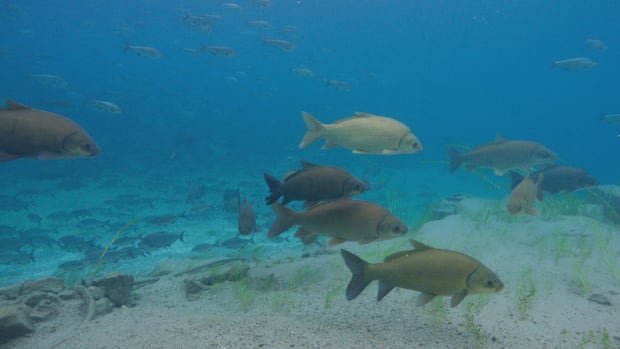

In Lake Huron, mesmerizing underwater scenes have led a documentary crew to dub a specific area “fish city,” showcased on Earth Day for its apparent abundance. However, the Saugeen Ojibway Nation (SON) refutes this portrayal, describing the zone near the warm-water outflow of the Bruce Nuclear Generating Station as a “fish trap.”
SON highlights the deaths of up to five million gizzard shad in 2025, documented by the Department of Fisheries and Oceans (DFO) in a Canadian Nuclear Safety Commission regulatory report. This mass mortality event occurred when an influx of fish obstructed the cooling water intake systems, prompting a proactive shutdown of Bruce A Unit 2 by the utility.
Additionally, SON reports incidents involving lake sturgeon, an at-risk species deemed culturally significant in Anishnaabe traditions, becoming stranded in a forebay pond at the nuclear plant. While one sturgeon was rescued in November, three others remain in the pond.
The controversy surrounding “fish city” extends beyond mere imagery, raising concerns about how Bruce Power mitigates ecological risks while seeking regulatory approval to enhance plant limits for increased electricity production.
Bruce station, the largest nuclear plant in North America, releases warmer water into Lake Huron as part of its cooling system. Although fish are attracted to this area, regulators did not attribute the 2025 fish die-off to the plant.
Ryan Lauzon, a biologist with SON, conducted a comprehensive study on the 2025 fish kill, indicating that the site operates in two stages: attraction and entrapment. He explains that the warm waters act as bait, drawing fish into the plant’s forebay where they struggle to exit, putting them at risk.
Bruce Power refutes claims that the plant caused the 2025 die-off, attributing the event to unusual environmental conditions like high shad numbers and severe winter weather. The utility has implemented various deterrents and monitoring measures to prevent fish from entering its system.
In August 2025, Bruce Power requested regulatory approval to increase electricity generation from its existing reactors without constructing a new one. This initiative aims to raise output by approximately 11% by 2030 to meet growing provincial electricity demand while adhering to environmental constraints.
Despite operating under stringent regulations, a 2024 report highlighted the absence of clear benchmarks for assessing acceptable levels of fish deaths related to plant operations. This ambiguity underscores the challenge in determining when fish losses become unacceptable.
The ecological impact of the gizzard shad die-off is emphasized by Paul Jones, a former fisherman and councilor with the Chippewas of the Nawash Unceded First Nation. He stresses the importance of shad in the lake ecosystem and their cultural significance in Anishnaabe teachings, underscoring the need to address the ecological effects of such events.