
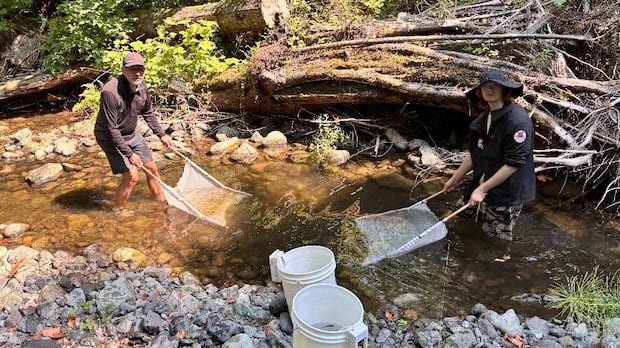

Parts of British Columbia are experiencing severe drought conditions this summer, leading to water use restrictions in Bessette Creek to protect salmon populations from low flows. Temporary protection orders for the Salmon River watershed were issued and rescinded due to increased wildfire risk. The Cowichan Lake Salmonid Enhancement Society is manually rescuing fish from drying rivers through a process called fry salvage. Efforts involve moving fish to areas with more water, aided by aerators and bubblers to ensure oxygen supply. The society has observed streams drying up farther upstream than before, making the rescue operations more challenging.
Collaborating with the Ts’uubaa-asatx Nation and volunteers, the society relocates fish, including salmon, trout, and char. The changing climate has made the work more difficult, with streams drying up at greater distances upstream. The Ts’uubaa-asatx Nation plays a crucial role in the fry salvage efforts, using drones to monitor drying streams. The community’s strong connection to salmon drives their investment in conservation projects for the future.
Similar challenges are faced in France, where severe drought conditions have impacted fish relocation efforts. Unprecedented heat waves have caused rivers to dry up, leading to intense competition among fish for limited resources. Fish physiological stress and energy loss are exacerbated by rising water temperatures, posing a threat to their survival. The focus is shifting towards ecosystem restoration and water-use management rather than short-term rescue operations, as moving fish can add stress and incur high costs. In situations where a vast majority of the watershed is dry, the feasibility of large-scale fish relocation becomes questionable.