
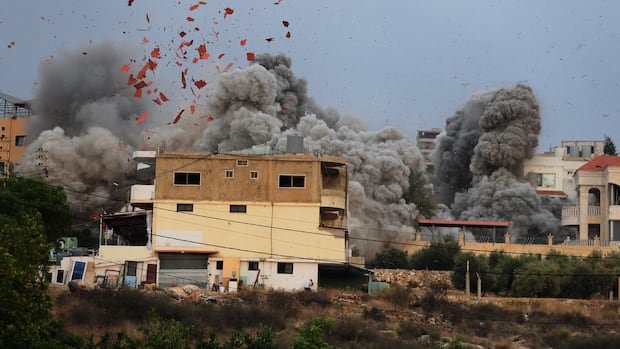

Israeli fighter jets conducted airstrikes in several southern Lebanese towns, intensifying their frequent attacks on the country. The bombings occurred in violation of a ceasefire agreement from November 2024, following Hezbollah’s call on the Lebanese government to refrain from engaging in negotiations with Israel.
Residents in Tayba, Tayr Debba, and Aita al-Jabal were advised by Israeli spokesperson Avichay Adraee to evacuate 500 meters from targeted residential buildings allegedly utilized by Hezbollah. Subsequently, warnings were issued for Zawtar al-Sharqiyah and Kfar Dounin. Lebanon’s civil defense assisted in evacuating the areas, with most residents leaving before the strikes. The Lebanese health ministry reported one person injured during the attacks, while an earlier Israeli airstrike on the same day resulted in one fatality.
The Israeli military claimed to have targeted Hezbollah’s military infrastructure, including weapons storage facilities situated in civilian-populated regions. They accused the militant group of rearming nearly a year after the ceasefire brokered by the U.S. came into effect. Despite the truce, Hezbollah refrained from launching attacks on Israel.
Since the ceasefire implementation, over 270 individuals have lost their lives, and around 850 have been wounded due to Israeli military operations, as reported by Lebanon’s health ministry. The United Nations confirmed that 107 of the casualties were civilians or noncombatants by October 9. Israeli government spokesperson Shosh Bedrosian reiterated Israel’s commitment to defending its borders and enforcing the ceasefire agreement with Lebanon.
The recent airstrikes destroyed an ironworks establishment in Abbasiyeh, impacting several households, according to the owner, Ahmad al-Kayyal. Concerns have grown in Lebanon about a potential resurgence of widespread aerial bombings by Israel, especially following warnings of action against Hezbollah if Lebanon failed to disarm the group.
Lebanese Prime Minister Nawaf Salam and his administration convened in Beirut to review a military-drafted plan aimed at disarming Hezbollah and other non-state armed groups in the country. President Joseph Aoun criticized Israel’s strikes and military presence on Lebanese territory, instructing the army to confront any Israeli incursions into southern Lebanon.
Aoun expressed willingness to engage in negotiations with Israel to alleviate tensions, a stance opposed by Hezbollah. The group asserted its right to resist Israeli occupation and pledged support to the Lebanese army while maintaining that Lebanon, though bound by a ceasefire, was not obligated to enter into political talks with Israel.
Hezbollah’s military capabilities were significantly weakened during Israel’s air campaign in 2024, but the group’s leader, Sheikh Naim Qassem, affirmed their readiness to fight despite limited capabilities. Lebanese security officials indicated progress on disarmament efforts, with the army targeting the removal of non-state-controlled arms in southern Lebanon by year-end.
Simultaneously, the U.S. Treasury announced new sanctions targeting financial facilitators overseeing funds transfer from Iran to Hezbollah. Allegations of ceasefire violations persist between Israel and Hezbollah, stemming from the aftermath of the latest conflict initiated by a Hamas-led attack on Israel in October 2023, escalating into a full-scale war by September 2024.