
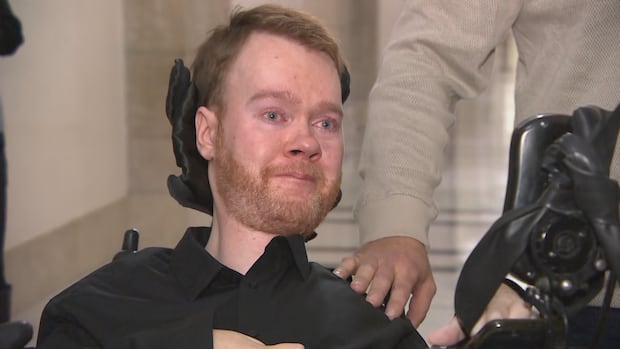

As Jeremy Bray processed the news that Manitoba’s government would not fund his crucial treatment, tears welled in his eyes.
At 30 years old, Bray suffers from a degenerative condition that progressively diminishes his muscle control. He had a meeting with Health Minister Uzoma Asagwara on Monday after urging the NDP government to finance the medication while he still has some level of autonomy.
Currently, he can only move his mouth, certain parts of his face, and one thumb.
“All I ask is for the province that I have called home my entire life — the province I cherish — to assist me by providing treatment that I know is beneficial,” Bray expressed to reporters following the meeting.
Bray, diagnosed with Type 2 spinal muscular atrophy, has been receiving the medication risdiplam — marketed as Evrysdi — for over six months, after Asagwara successfully convinced Roche, the drug’s producer, to extend complimentary coverage for compassionate reasons.
Bray shows positive response to the medication
The province hoped that Bray’s positive experience with the medication would persuade Canada’s Drug Agency (CDA) to endorse the treatment for adults aged 25 and above. The agency has stated that insufficient evidence exists because individuals in that age group did not participate in clinical trials.
After six months of treatment, Bray has noted improvements such as a stronger voice, increased facial expressiveness, and the ability to work longer hours as a data consultant before needing to rest.
However, last week, Bray learned that Roche would cease providing the medication at no cost, prompting him to seek the NDP government’s reconsideration.
Before his meeting, he shared with CBC News that he felt “hopeful” the province might alter its stance, but that did not occur.
“I just want a chance,” he said, while his father wiped away a tear.
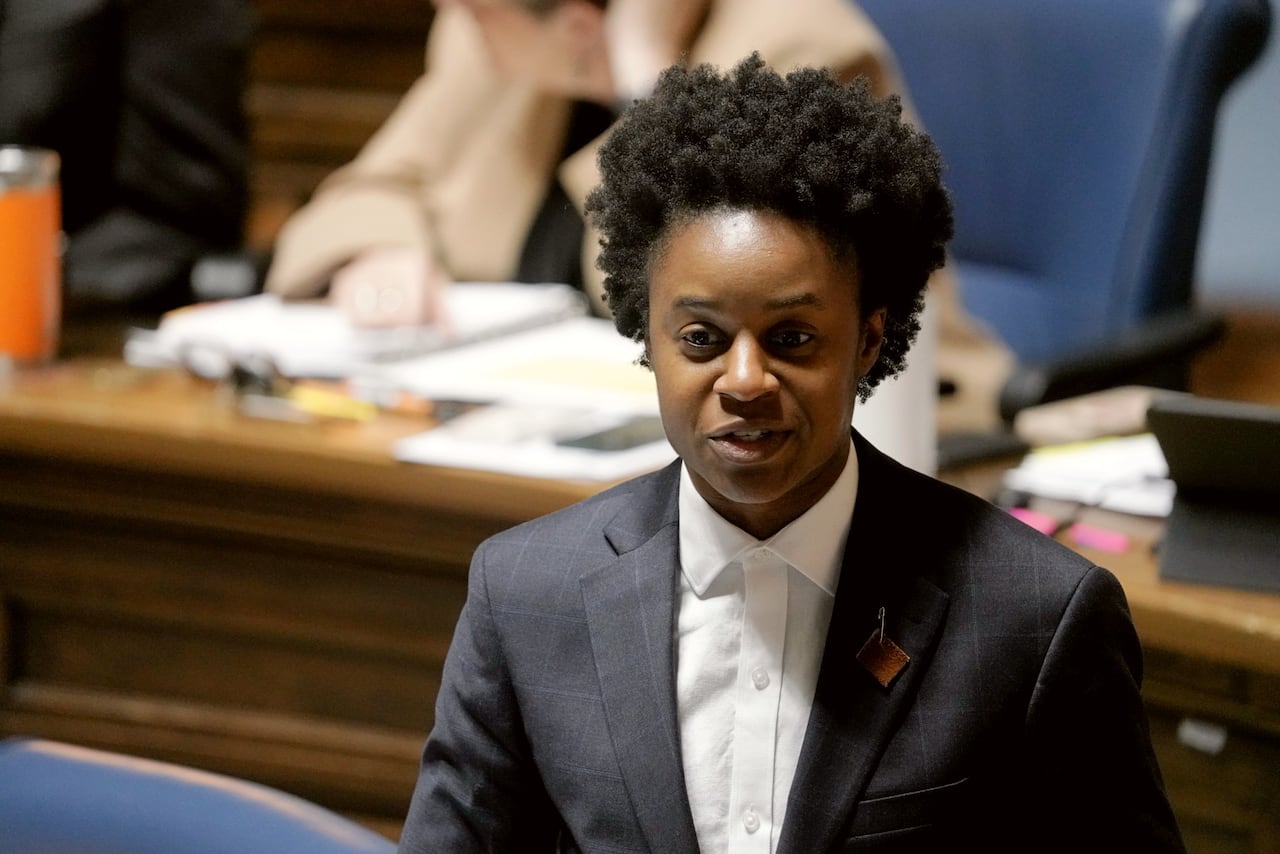
Health Minister Uzoma Asagwara has maintained that they will not override the guidance from Canada’s Drug Agency, but they are hopeful the agency will consider more real-world evidence, including Jeremy Bray’s experience with the drug. (Bryce Hoye/CBC)
He aimed to continue the treatment for a full year, at which point an evaluation would determine whether he should remain on the medication.
“I have no doubt that it will demonstrate my positive response to the treatment,” he stated.
Asagwara reiterated that Manitoba would not disregard the federal drug agency’s guidelines, which are designed to coordinate drug policies across provinces and territories. In response to Bray’s requests, the province has sought an “urgent review” from the agency regarding the medication, but the agency has indicated there isn’t sufficient evidence to amend its decision.
In contrast, Quebec does not impose age restrictions for access, while the patient advocacy group SMA Canada reports that provinces like Alberta and Ontario have funded treatments for adults over 25 in certain instances.
Darren Bray, Jeremy’s father, suspects that Manitoba’s hesitance is financially motivated. The high-cost treatment is estimated to be around $300,000 for the first year.
-
A Manitoban is losing his ability to move his muscles. A drug might prevent that, but the province won’t pay
-
Free drug coverage ended, Manitoban battling degenerative disease asks province to step up
“They’re relying on the vague recommendation from the CDA,” he told reporters.
“They could easily approve Jeremy today, as many other provinces have, but they’re simply unwilling to do so. It’s utterly absurd.”
Obby Khan, leader of the Progressive Conservatives, expressed his frustration at the government’s choice, labeling it “callous” and “heartless” during a news conference with the Bray family.
“I can’t fathom why the health minister and the premier would invite the family to the legislature with hopes that this might be the breakthrough they were looking for, only to inform them that the medication will not be approved. It’s heartbreaking.”
Khan mentioned that he had assured the family beforehand that he was confident the NDP would make the right choice.
“I suppose I’ve lost that bet now.”
‘We’re not going to give up on him,’ says dad
Any prospects for a new clinical trial to persuade Canada’s Drug Agency are unfeasible, as “there’s already so much evidence proving it works,” said Dr. Xavier Rodrigue, a physician in Quebec who treats spinal muscular atrophy patients, in a previous interview.
He argued that it would be unethical to conduct a study where some patients receive the treatment while others do not, as those deprived of the medication would face a decline in health.
Asagwara reiterated on Monday that they wish for Roche and the federal drug agency to collaborate and consider Bray’s experience as a “real-world clinical study” in hopes of influencing the agency to revise its recommendations.
“We will continue to advocate for Jeremy’s family,” the minister asserted.
Jeremy Bray mentioned that they will regroup and seek ways to finance his treatment moving forward.
“We will not give up on him,” Darren Bray added. “While the province may have, we will continue the fight.”
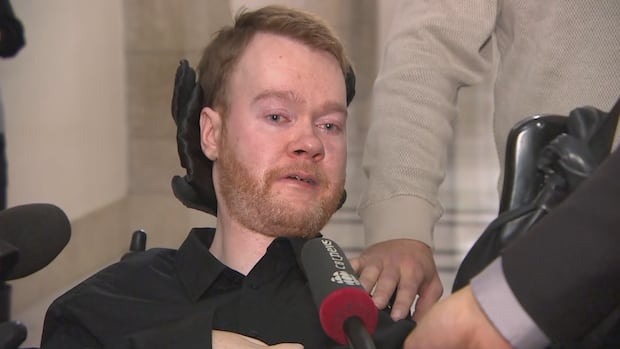
Jeremy Bray, who has spinal muscular atrophy, left a meeting with Manitoba’s health minister with tears welling in his eyes after the province continued to refuse to pay for a drug that can halt the disease’s progression — and maybe reverse some of its effects — unless Canada’s Drug Agency changes its mind.