
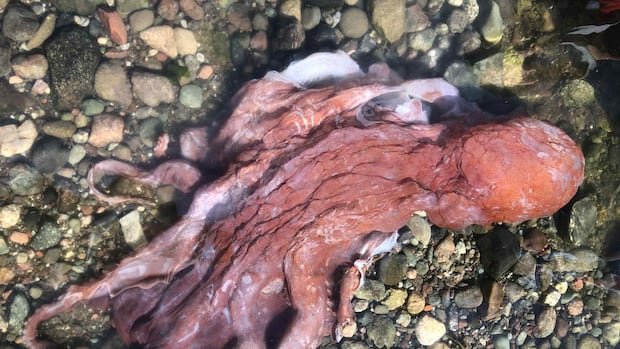

A scientist from Washington state has made an exciting discovery by identifying a seven-arm octopus, a species typically found in the Atlantic Ocean, on the coast of British Columbia. The unusual creature was found in August by Kathleen Durant, a resident of Pender Island, while she was walking her dog and initially mistook it for a large red jellyfish. However, upon closer inspection, she noticed an eye on the creature.
Curious about the mysterious find, Durant shared images of the creature on the Field Naturalists of Vancouver Island Facebook page, where marine biologist Casey Cook recognized it. Cook, upon analyzing the images, determined that it was an octopus rather than a squid based on the suction cups on its arms. Through research and comparison of images, Cook identified the species as the seven-arm octopus, also known as Haliphron atlanticus or septopus.
Although the species is primarily found in the Atlantic, there have been a few sightings of seven-arm octopuses on the Pacific coast in recent years. Cook mentioned a similar incident reported in a 2020 article by the Whidbey News-Times in Washington state, indicating the occasional appearance of these creatures in the region.
The biologist highlighted the changing climates and currents as potential factors contributing to these sightings on the Pacific coast. Cook speculated that the octopus might have been transported to the area through ballast water or other means, or they could be native to the region, yet to be fully understood by scientists.
While acknowledging the slim possibility of the octopus being a Pacific species, Cook emphasized the resilience of the specimen, noting its apparent good health and lack of injuries. She suggested that the creature seemed to be thriving in its environment, raising questions about its adaptation to the Pacific waters.
The discovery of the seven-arm octopus on Pender Island has sparked interest and intrigue among researchers, urging further exploration and study of marine life in the Salish Sea.