
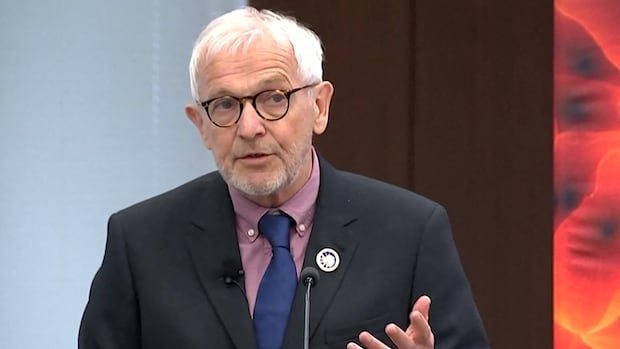

Belgian-American physicist Francis Halzen, aged 82, has been named the recipient of the 2026 Nobel Prize in Physics in Stockholm. The award acknowledges his significant contributions to the IceCube Neutrino Observatory and the identification of high-energy neutrinos from astrophysical sources. Situated at the Amundsen–Scott South Pole Station in Antarctica, the observatory was a product of Halzen’s realization that ice in the South Pole could serve as a medium to track neutrinos, dubbed “ghost particles” for their ability to pass through matter almost undetected.
Eva Olsson of the Royal Swedish Academy of Sciences described these neutrinos as messengers from the cosmos, shedding light on distant galaxies and the phenomena of exploding stars. The annual Nobel physics prize, which includes a prize sum of 12 million Swedish crowns ($1.7 million Cdn), is conferred by the Royal Swedish Academy of Sciences.
The IceCube Observatory, covering an entire cubic kilometer, commenced operations in 2011, culminating a vision conceived in the late 1980s. Halzen expressed gratitude towards his colleagues over the years, acknowledging the initial skepticism surrounding the project’s success. Affiliated with the University of Wisconsin–Madison, Halzen reacted with delight and surprise to the announcement, made while he was attending a conference in Italy.
Neutrinos, extremely tiny cosmic particles with minuscule mass, are constantly streaming through the universe, originating from stars like the sun. Scientists study the interactions of neutrinos with matter, which produce flashes of light or charged particles, providing insights into the evolution of the universe. Mark Pearce, chair of the Nobel Committee for Physics, commended Halzen for his leadership in developing a groundbreaking tool that paves the way for a new era of astronomy.
A planned extension, IceCube-Gen2, spanning eight cubic kilometers of ice, is slated to become operational in 2033, increasing the observatory’s neutrino detection capacity significantly. Halzen emphasized that the full impact of his work is yet to be seen, underscoring the ongoing exploration of astronomy.
Belgian Prime Minister Bart De Wever hailed Halzen’s dedication to unraveling cosmic mysteries through his scientific endeavors. The Nobel Prize in Chemistry, literature, peace, and economics will be announced in the following days, with the laureates set to receive their awards on December 10, the date of Alfred Nobel’s passing.
[End of rewritten article]