
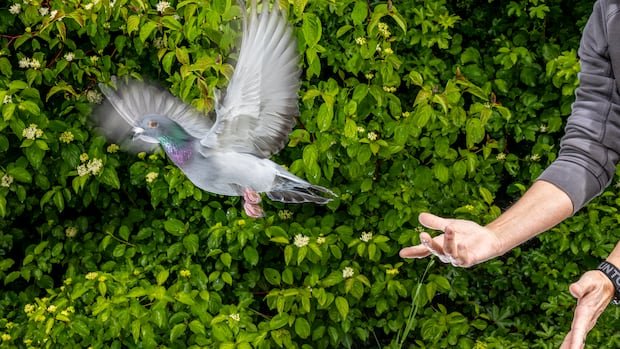

Scientists have made a groundbreaking discovery regarding the navigation mechanism of pigeons. Cher Ami, a heroic pigeon from World War I, exemplified the vital role of these birds in delivering crucial messages under challenging circumstances. Throughout history, pigeons have been relied upon to carry messages over long distances, from ancient Olympic announcements to breaking news delivery.
Researchers have long understood that homing pigeons navigate using various cues such as the sun, scents, visual landmarks, and the Earth’s magnetic field when traditional cues are unavailable. However, the mystery has persisted regarding how pigeons detect and utilize this magnetic information effectively.
A recent study led by Clivia Lisowski and her team proposes a novel theory that iron-rich immune cells in the liver may serve as sensors for detecting the Earth’s magnetic field and aiding in the birds’ navigation. The research stemmed from earlier findings in mice, demonstrating that immune cells in the spleen accumulate iron and are sensitive to magnetic fields. This discovery led to a collaborative effort to explore if similar cells exist in birds, ultimately pointing to the liver as the primary location for these cells.
The study revealed that macrophages, a type of immune cell found in the liver, play a crucial role in processing iron from old red blood cells. These macrophages are closely situated near nerve fibers, suggesting a potential pathway for transmitting magnetic information to the pigeon’s brain. Experimental tests involving the temporary depletion of macrophages in pigeons resulted in significant navigation challenges, highlighting the essential role of these cells in the birds’ ability to orient themselves.
Experts, including wildlife biologist David Bird and avian research director Scott MacDougall-Shackleton, have lauded the research’s significance in shedding light on how animals, including migratory birds and potentially other species, navigate using internal compasses. The study not only provides valuable insights into avian navigation but also prompts further exploration of the liver’s unexpected sensory capabilities.
The research has sparked a paradigm shift in understanding the immune system’s functions, revealing its sensory role beyond pathogen defense. This innovative study opens up new avenues for investigating how organisms interact with and perceive their environment, challenging conventional perspectives on the immune system’s capabilities.