
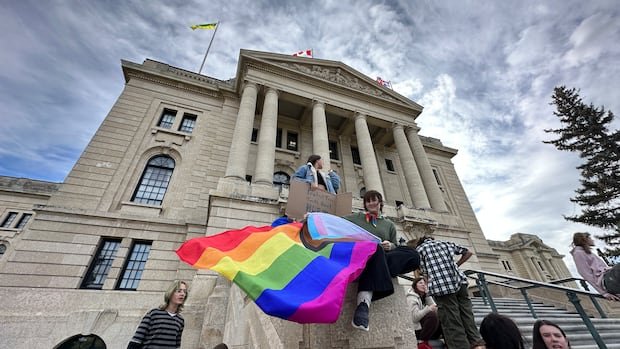

The president of the Saskatchewan Teachers’ Federation expressed optimism about the Supreme Court shedding light on the province’s pronoun law following the court’s decision to hear appeals on the matter. The law currently prohibits children under 16 from altering their names or pronouns at school without parental consent, leading to challenges faced by teachers, as noted by Samantha Becotte.
Becotte emphasized the need for the government of Saskatchewan to repeal Bill 137 to grant teachers professional autonomy. She stressed the importance of allowing teachers to exercise their professional judgment in creating safe learning environments for all students in Saskatchewan.
A specific date for the court hearing regarding the cross appeals from the provincial government and UR Pride, a 2SLGBTQ+ group in Regina, has not been scheduled yet. The Saskatchewan Party government, under Premier Scott Moe, introduced the pronoun law policy in 2023, arguing that parental involvement in school decisions is essential.
Legal representatives for UR Pride challenged the law in court, asserting that it infringes on Charter rights and adversely impacts gender diverse youth. An injunction was initially granted to halt the policy, but the province later enacted it into law and invoked the notwithstanding clause, allowing the override of certain Charter rights for a period of five years.
The Saskatchewan Court of Appeal ruled that the challenge against the law can proceed despite the notwithstanding clause invocation. The court clarified that while it cannot strike down the legislation due to the clause, it can issue a declaratory judgment on whether the law violates constitutional rights. UR Pride was also permitted to argue for the law’s annulment since the notwithstanding clause did not apply to Section 12 of the Charter, which addresses the right to be free from cruel and unusual treatment.
Both UR Pride and the province appealed the decision, seeking an expedited hearing at the Supreme Court of Canada alongside a similar challenge in Quebec concerning a law restricting public sector workers from wearing religious symbols.
Adam Goldenberg, a lawyer representing UR Pride, asserted that the law violates Charter rights and harms gender diverse youth, emphasizing the need for the government to defend the law with evidence. He highlighted the importance of giving a voice to gender diverse youth in the legal proceedings.
Louis-Philippe Lampron, a constitutional law professor at Université Laval in Quebec, viewed the Supreme Court’s acceptance of the case as a reflection of the evolving Canadian legal landscape and highlighted the potential misuse of the notwithstanding clause to cater to populist sentiments.
Meanwhile, a comparable legal dispute is emerging in Alberta, where Premier Danielle Smith’s government recently utilized the notwithstanding clause to prevent a provincewide teachers strike and protect its back-to-work legislation. Plans to use the notwithstanding clause in legislation concerning school pronouns, female sports, and gender-affirming health care have also been disclosed.
The laws in Alberta face legal challenges, with one bill temporarily halting doctors from providing gender-affirming health care to minors. Another bill mandates parental consent for youth to use different names or pronouns in school, while a third prohibits transgender girls from participating in amateur female sports.
While Smith has not made a final decision on invoking the notwithstanding clause, she suggested it might be necessary due to the potentially lengthy court processes required for resolving these contentious issues.