
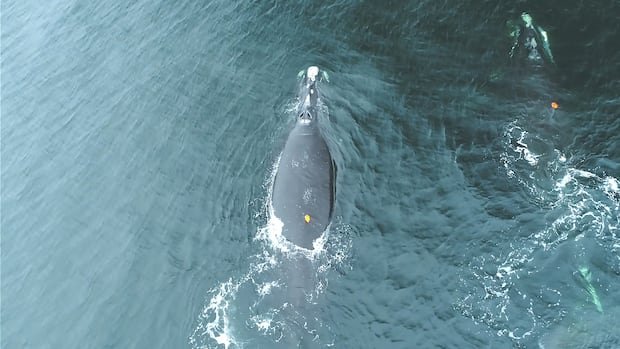

A recent research study has revealed that North Atlantic right whales, a critically endangered species, are engaging in surface feeding at night, which puts them at a higher risk of collisions with boats. The findings were published in the scientific journal PLOS One earlier this month, shedding light on the whales’ behavior and the potential dangers they face.
Led by Jay Kirkham, a PhD student at Dalhousie University in Halifax, the study involved tagging 23 North Atlantic right whales in the Shediac Valley, located in the southern Gulf of St. Lawrence. This area serves as a feeding ground for a portion of the estimated 384-strong North Atlantic right whale population during the summer months.
The tagged whales were monitored using video footage and data tracking their movements and feeding patterns. Kirkham explained that the whales exhibit distinct feeding behaviors during the day, with their mouths acting like a parachute, slowing them down and requiring more effort to feed by kicking their tails faster.
To address the challenge of identifying nighttime feeding behavior, Kirkham employed machine learning algorithms trained on the observed video data. The analysis revealed that whales feed at similar depths to large vessels at night, heightening the risk of collisions due to their proximity.
While North Atlantic right whales typically feed near the sea floor during daylight hours, they follow their prey, zooplankton, higher up in the water column at night. This behavior increases the likelihood of overlap with ships transiting the area, potentially leading to fatal encounters.
Collisions with vessels and entanglement in fishing gear are identified as the primary causes of mortality among North Atlantic right whales. The study’s findings could inform conservation strategies aimed at safeguarding the whale population.
Current protection measures overseen by Transport Canada and Fisheries and Oceans Canada focus on preventing entanglements in fishing gear, implementing speed restrictions, and establishing vessel exclusion zones in critical areas like the Shediac Valley during the summer. These initiatives aim to reduce the risk of collisions between boats and right whales.
Despite these efforts, Kirkham noted that a significant portion of the tagged whales spent a quarter of their feeding time outside the designated vessel exclusion zone, exposing them to potential ship traffic hazards. Transport Canada highlighted its surveillance program utilizing visual and audio detection tools to enhance whale protection and informed decision-making when whales are present.
Both departments emphasized the importance of leveraging cutting-edge research, monitoring data, and stakeholder feedback to bolster protection measures for North Atlantic right whales and mitigate the threats they face, including collisions with vessels and fishing gear entanglements.