

UPDATE, Nov. 6, 9:37 p.m. PT — Michael Grenier, in charge of Area J in the Thompson-Nicola Regional District (TNRD), confirmed that recent water tests have verified the water quality in compliance with B.C. standards for drinking, wildlife, and irrigation as of Thursday. The TNRD water systems are operational, with private water system operators duly informed of the test outcomes. Continuous water testing will be conducted.
Original story:
Communities situated along Kamloops Lake in British Columbia have started shutting down their water intake systems following the revelation that over 80,000 liters of aviation fuel were spilled along its shores during a recent train derailment incident last weekend, according to a local official.
The spill size estimate by the province was revised upwards late Wednesday, prompting a request for water quality reports from Michael Grenier, the director for Area J of the Thompson-Nicola Regional District.
Grenier expressed concern stating that the spill is significantly larger than initially anticipated, raising apprehensions for communities reliant on the lake and downstream for their water supply.
He emphasized the urgency to receive the water test results that the district insisted on obtaining on Wednesday.
Results from samples collected on Sunday and Monday have been received and reviewed by the Interior Health authority, as confirmed by B.C.’s Environment Ministry.
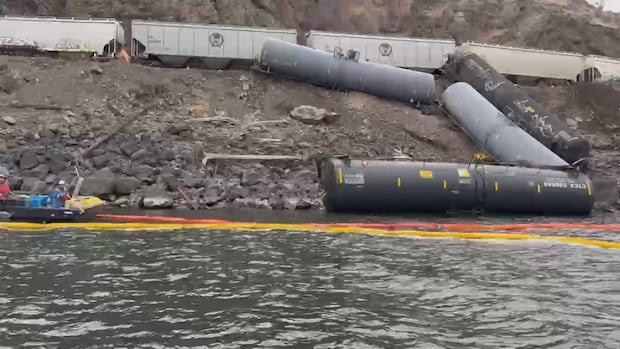
Canadian Pacific Kansas City (CPKC) reported that the derailment incident occurred on Saturday night, approximately 20 kilometers west of Kamloops, involving a locomotive and 17 railcars, two of which were transporting aviation fuel.

Clean-up work is underway after a train derailed and spilled fuel near Kamloops, B.C.
As the CBC’s Jacqueline Gelineau reports, the Canadian Pacific Kansas City locomotive was carrying fuel and gypsum when it derailed Saturday evening.
The Environment Ministry stated on Tuesday that around 12,700 liters of aviation fuel had been released into the environment, but this figure was revised on Wednesday to an additional 68,000 liters escaping from a second railcar.
At the derailment site, three empty railcars with residual gasoline are present, with one positioned on the slope leading to the lake and the other two in the water.
Grenier anticipates negative contamination results from the tests but highlighted that precautionary measures have been implemented as a safety measure.