
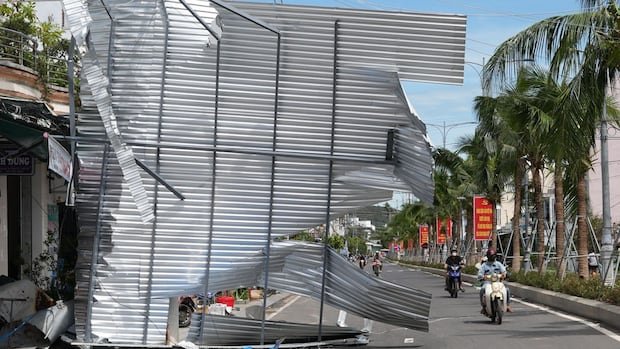

Vietnamese officials reported that at least five individuals lost their lives as a result of the destructive winds and heavy rainfall brought by Typhoon Kalmaegi. The storm, which had already caused the deaths of 188 individuals in the Philippines, made landfall in central Vietnam on Thursday, causing significant damage to the region.
Upon its arrival, the typhoon uprooted trees, inflicted damage to homes, and led to power outages before gradually losing strength as it moved further inland. Authorities issued warnings of continued heavy rainfall in central provinces, with potential flooding and landslides expected in various areas.
One individual, shrimp farm owner Nguyen Dinh Sa from Gia Lai province, shared his despair over the catastrophic losses he endured due to the typhoon. He recounted the destruction of approximately six metric tons of shrimp and expressed the devastation of losing all his investments in the calamity.
The storm’s impact was visible along the coast, with toppled trees, shattered glass, and scattered roofing sheets. Residents were seen relying on generators to recharge their electronic devices amid the aftermath.
According to Vietnam’s disaster management agency, seven individuals sustained injuries, around 2,800 homes were damaged, and 1.3 million people were left without electricity. The country’s railway system in Quang Ngai also suffered damage, prompting mobilization efforts for search-and-rescue operations.
Philippines president assesses Cebu damage
In the Philippines, President Ferdinand Marcos Jr. visited evacuation centers to provide relief aid and reassurance to victims following Kalmaegi’s impact, which left 135 individuals missing and 96 injured. The president expressed condolences to those affected by the flash floods caused by the storm.
Typhoon Kalmaegi marks the 13th storm to develop in the South China Sea this year, highlighting the vulnerability of both Vietnam and the Philippines to tropical storms and typhoons due to their geographical locations. The Philippines is currently on high alert as another typhoon, Fung-wong, is projected to intensify into a super typhoon before hitting the northern region of the country.
The impending typhoon’s forecast suggests a potential landfall in northern Aurora province, with anticipated impacts on the densely populated capital region of Manila.